If you’re a blogger or website owner, the best AI ranking tools for SEO analysis help you track both traditional keyword positions and AI answer visibility without constant manual checking. These tools show when your content is mentioned, cited, or replaced in AI Overviews and other AI platforms.
They are not the same as AI writing or content-optimization platforms. This guide focuses specifically on tracking: traditional rankings plus monitoring of AI Overviews, citations, and brand mentions. The goal is to help you focus on posts that already earn visibility and decide which ones are worth updating.
For a broader view of what’s available, browse the best AI ranking tools for SEO analysis options, then narrow down to the ones that match your workflow and budget.
Estimated reading time: 12 minutes

Table of Contents
What “AI Ranking Tools” Actually Measure
The term covers several related but distinct jobs:
- Traditional keyword and position tracking: Where your pages rank in classic Google (or other) results on desktop/mobile, by location.
- AI Overview and AI answer citations: Whether your pages are cited as sources in Google AI Overviews or similar generative answers.
- Brand mentions and sentiment across AI platforms: How often your brand, product, or name appears in answers from ChatGPT, Gemini, Perplexity, Claude, Copilot, etc.
- AI-assisted keyword research and content optimization: Tools that help generate ideas, score content, or write (outside the scope of this list).
Not every tool does all of these. Some specialize in AI citations only; others combine traditional rank tracking with AI visibility. 👉 Knowing the difference prevents mismatched expectations.
How These Best AI Ranking Tools For SEO Analysis Were Selected
I evaluated these eight best AI ranking tools for SEO analysis primarily on published features, pricing, platform coverage, and practical fit for bloggers, solo publishers, and small teams (not hands-on enterprise testing of every plan). Key criteria included:
- Traditional rank tracking capabilities.
- AI visibility/citation/mention tracking (which platforms).
- Ease of setup and reporting.
- Pricing transparency and limits.
- Fit for solo bloggers, small businesses, or multi-site/agency use.
Prices and features change frequently; always verify current details on the vendor’s site. Where exact limits weren’t publicly confirmed, I’ve noted that.
Quick Comparison Table
These are some of the best AI ranking tools for SEO analysis if you need both traditional ranks and AI visibility.
| Tool | Traditional Rank Tracking | AI Visibility / Citations | Best Fit | Starting Price (approx., Oct 2026) |
|---|---|---|---|---|
| Google Search Console | Yes (impressions, clicks, position) | No direct AI citation data | Free validation for any blogger | Free |
| SE Ranking | Yes (strong) | Yes (AI Overviews + other models via prompts) | Bloggers wanting broader SEO toolkit + AI tracking | ~$103/mo annual (Core) |
| Otterly AI | Limited / focused on AI | Strong (citations & mentions) | Solo publishers wanting simple AI citation monitoring | $29/mo (Lite) |
| Rankscale AI | Limited | Strong (multi-platform AI search) | Multi-site or flexible credit-based tracking | ~$20/mo (Essentials) |
| Keyword.com AI Tracker | Yes (core strength) | AI visibility features available | Budget-conscious citation + rank tracking | Low entry (credit/plan based; verify) |
| Peec AI | Limited | Strong brand/mention tracking | Personal brands & small businesses | ~$89–95/mo |
| Mangools SERPWatcher | Yes (lightweight) | Limited AI depth | Beginners/budget users needing simple tracking | ~$30–38/mo |
| Nightwatch | Yes (strong) | Yes (multiple AI platforms) | Users wanting rankings + AI visibility in one place | €79/mo annual (Starter) |
Prices are directional and change; confirm on each site. Some tools offer trials.
The Best AI Ranking Tools For SEO Analysis
1. Google Search Console (Free Reality Check)
What it tracks: Impressions, clicks, average position, and query/page performance in traditional Google Search.
Platforms: Google Search only.
Reporting/alerts: Performance reports, filters by page/query/device; no built-in AI citation alerts.
Best fit: Every blogger as a free baseline and validation layer.
Limitations/pricing: Free. Does not directly report AI Overview citations or brand mentions in ChatGPT/Perplexity/etc. Use it to check whether traditional impressions/clicks/position also moved when an AI tracker shows a change.
Google Search Console won’t label “AI Overview share” directly, but it’s still one of the best free ways to confirm what your tracking tools suggest. If impressions jump while clicks drop, or if your average position holds steady but CTR slides, you have a strong signal that the SERP layout changed, often because answers appear higher up.
It’s also where you validate the impact of updates. After you refresh a post to match what AI Overviews cite (definitions, steps, comparisons, and clear headings), Search Console shows whether the page actually regained attention in search behavior. You can also track AI citations on Bing for free additional context.
Learn more about using Google Search Console for finding your AI overviews in the video below:
2. SE Ranking
What it tracks: Traditional keyword rankings (desktop/mobile, locations) plus AI prompt tracking and visibility (AI Overviews and other models).
Platforms: Major search engines + AI surfaces via prompts.
Reporting/alerts: Rank tracking, audits, keyword tools, and AI visibility reports with history.
Best fit: Bloggers or small businesses who want rank tracking, audits, and AI monitoring in one subscription instead of multiple tools.
Limitations/pricing: Core starts around $129/mo ($103.20 annual) with daily keyword tracking and a set number of AI prompts (higher tiers or AI Search add-on expand capacity). Stronger for broader SEO work than pure AI-only trackers.
SE Ranking makes sense if you want a broader SEO toolkit while still keeping an eye on AI Overviews. You’re not only tracking AI mentions, but you’re also managing the basics that keep your blog healthy. Such as audits, keyword tracking, and ongoing optimization tasks.
This matters because AI Overview visibility doesn’t exist in a vacuum. If a page slows down, loses links, or slips in traditional rankings, it may become less likely to be cited. SE Ranking is a good fit for a blogger who wants fewer subscriptions, even if it costs more than a niche AI-only tracker.
3. Otterly AI
What it tracks: Brand and page appearances/citations across AI assistants (Google AI Overviews and others).
Platforms: Typically ChatGPT, AI Overviews, Perplexity, Copilot; additional engines as add-ons.
Reporting/alerts: Visibility trends, alerts for changes, citation views.
Best fit: Solo bloggers or smaller sites that want fast, focused AI citation monitoring without a full SEO suite.
Limitations/pricing: Lite starts at $29/mo (15 prompts, core engines). Higher tiers add more prompts and features; some engines (e.g., Claude, Gemini, AI Mode) may be add-ons. Simple interface but narrower than all-in-one platforms.
Otterly AI is built for people who want fast visibility into AI results. You won’t feel like you’re learning a new enterprise platform. If you’re running a smaller blog or a solo site, that simplicity saves you hours.
You track where your brand appears across major AI assistants, including Google AI Overviews, and get alerts that help you catch changes before your traffic reports make them obvious. It’s especially helpful when you’re trying to confirm, “Did my guide actually get cited, or did an AI answer switch to other sources?”
4. Rankscale AI
What it tracks: AI search visibility—how often your site appears, gains/losses in mentions, and which pages get cited.
Platforms: Multiple AI answer engines (credit-based queries).
Reporting/alerts: Appearance frequency, cited pages, trend monitoring; dashboards and exports on higher plans.
Best fit: People managing multiple sites, topic clusters, or variable tracking volume.
Limitations/pricing: Credit-based model (Essentials around $20/mo; higher plans with more credits and dashboards). Flexible but requires managing credits; less focused on traditional keyword ranks.
Rankscale AI focuses on AI search tracking across platforms and tends to appeal to those managing multiple sites, client projects, or topic clusters. Credit-based models can work well when your tracking needs change month to month.
This type of tool is useful when you care less about a single keyword’s rank and more about the bigger pattern: how often your site appears in AI answers, whether you’re gaining or losing mentions, and which pages get cited repeatedly.
5. Keyword.com AI Tracker
What it tracks: Keyword rankings plus AI citation/visibility features.
Platforms: Traditional search + AI visibility options.
Reporting/alerts: Practical for monitoring specific money posts and citation changes.
Best fit: Bloggers who want citation tracking without paying for a large enterprise SEO platform.
Limitations/pricing: Entry pricing is among the more affordable options (credit or plan-based—verify current rates). Good for focused tracking of high-value posts.
Keyword.com AI Tracker works well when your main goal is to track citations and visibility without paying for a large-scale SEO platform. For many bloggers, that’s the sweet spot because you’re trying to protect traffic and revenue while keeping overhead low.
It’s also practical if you’re monitoring a specific set of money posts. You can focus tracking on the keywords that drive affiliate clicks, course sales, or service leads, then watch for AI Overviews that directly answer the query. That clarity helps you decide whether to update the post, expand it, or build a stronger supporting article to serve as the cited source.
6. Peec AI
What it tracks: Brand references, visibility trends, and mentions in AI answers (less about individual blue-link ranks).
Platforms: Multiple AI models (choice of engines on plans).
Reporting/alerts: Visibility trends, competitor shifts, brand-level monitoring.
Best fit: Personal brands, product sites, or small businesses that need to protect and monitor their references.
Limitations/pricing: Starts around $89–95/mo for entry plans with a set number of prompts and models. Strong for brand monitoring; not a full traditional rank tracker.
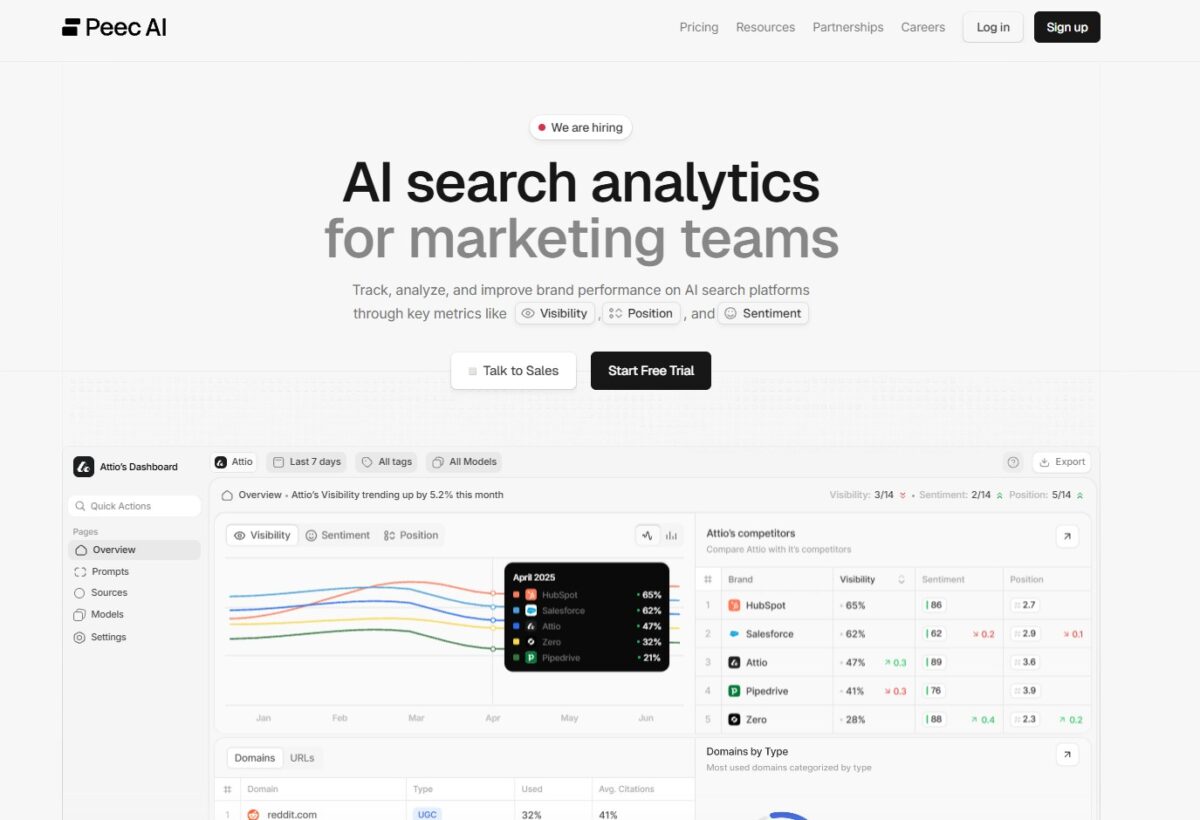
Peec AI is a good fit when your blog is tied to a personal brand, product, or small business name that you need to protect. It’s less about obsessing over individual blue-link rankings and more about knowing where and how you’re being referenced across AI answers.
That matters because bloggers often win with recognizable expertise. When AI tools quote you, cite you, or summarize your process, your brand becomes the shortcut people remember. Peec AI helps you track visibility trends and notice when competitors start taking your place for the same prompts and topics. (It’s one of the tools I used for a while.) The price starts at $89 per month.
7. Mangools SERPWatcher (Lightweight Option)
What it tracks: Keyword performance and rankings (clean, simple view).
Platforms: Primarily traditional search; lighter AI Overview depth than AI-first tools.
Reporting/alerts: Straightforward rank monitoring.
Best fit: Beginners or budget users who want consistent tracking without complexity.
Limitations/pricing: Part of the Mangools suite (starting roughly $30–38/mo depending on plan and billing). Limited deep AI citation features compared with dedicated AI trackers. Lightweight is often better than no tracking.
Mangools SERPWatcher is a simpler tracker and a reasonable pick if you’re starting out or only need light monitoring. You won’t get the same depth of AI Overview visibility features as AI-first tools, but you do get a clean way to keep your keyword performance in view.
This can still help with AI Overviews because when you see ranking changes for key terms, you know where to look more closely. For bloggers on a tighter budget, lightweight tracking is often better than no tracking at all. It works especially when you’re trying to stay consistent without drowning in data.
8. Nightwatch
What it tracks: Classic Google (and other) rankings plus AI answer visibility across platforms.
Platforms: Traditional search engines + multiple AI platforms (ChatGPT, Claude, Gemini, Perplexity, AI Overviews, etc.).
Reporting/alerts: Daily tracking, alerts for changes/mentions, reporting for clients or weekly reviews; unlimited seats.
Best fit: Users who want traditional rank tracking and AI visibility in one dashboard with solid reporting.
Limitations/pricing: Starter around €79/mo annual (500 keywords + AI prompts); higher tiers scale keywords and prompts. Strong all-in-one feel for tracking; priced in euros.
Nightwatch stands out when you want a single place to track classic Google rankings and AI answer visibility without juggling multiple dashboards. It covers multiple AI platforms. You’re not stuck watching only Google AI Overviews as your audience shifts.
You’ll like it because it reduces manual checks. Instead of searching your keywords one by one, you monitor whether AI Overviews appear, whether your site is being mentioned, and how often competitors get the nod. It’s also built for reporting so that you can stay consistent with weekly updates and spot drops early.
When you’re comparing options, the AI visibility tools overview helps you frame what “AI visibility” tracking includes across platforms.
How to Act on the Data (Simple Workflow)
When a tool shows a visibility change:
- Check Google Search Console for the same period—did impressions, clicks, or average position also change?
- Confirm the exact query and page that lost or gained visibility.
- Review the actual AI answer and which pages it currently cites.
- Update the post only where it improves accuracy, clarity, structure, or usefulness (definitions, steps, comparisons, headings).
- Track the result over weeks rather than reacting to a single check.
👉 Search Console provides context but does not directly validate AI citations.
Recommendations by Use Case
- Blogger who wants free performance checks: Start with Google Search Console + occasional manual AI Overview checks. Add a low-cost tracker later if needed.
- Solo publisher who needs AI citation monitoring: Otterly AI or Rankscale AI for focused, affordable AI visibility.
- Small business that wants rank tracking and basic audits in one tool: SE Ranking or Nightwatch.
- Team that needs client reporting across multiple sites: Nightwatch or SE Ranking (with reporting features); evaluate Peec AI if brand mentions are the priority.
Frequently Asked Questions
AI SEO tools often include writing, optimization, keyword research, or content scoring. AI rank-tracking / visibility tools focus on monitoring positions, citations, and mentions.
This list is tracking-focused. For research and optimization, look at platforms such as Surfer, Clearscope, Frase, or all-in-one suites (separate from pure trackers).
SE Ranking and Nightwatch are the strongest examples here.
Platform coverage, prompt/credit limits, traditional ranking depth, reporting needs, and total cost versus the specific job you need done.
Dedicated content and research tools do that better. Tracking tools help you see results after you optimize.
No. It shows traditional search performance data that can provide useful context alongside dedicated AI trackers.
Conclusion
When choosing the best AI ranking tools for SEO analysis, consider your needs. The best AI ranking and visibility tools help you keep your blog visible, even when Google answers the question before readers see the first result. The best choice depends on how you work.
Nightwatch and SE Ranking are strong if you want broader tracking plus reporting, while Otterly AI, Rankscale AI, and Keyword.com AI Tracker keep things focused on AI mentions and citations.
👉 Once you pick a tool, the value appears quickly, with less manual checking and less wasted time. Use the data with Search Console, conversions, and content quality to decide which posts to improve. Visibility data is most useful as one part of a larger decision process.
What tools are you using today to check your AI overview rankings? I’d love to hear about it in the comments below.
Disclosure: This Inspire To Thrive blog post contains affiliate links. I may earn a commission from qualifying purchases at no extra cost to you. Some sections were drafted with AI tools and carefully reviewed/edited by me.

- How to Use Social Media for the Best Black Friday Deals of 2026 - October 19, 2026
- How to Identify and Prioritize Your Money Pages (And Why I Just Updated Mine in Link Whisper) - October 19, 2026
- How to Build a Strong Online Presence for Solopreneurs in 2026 (Without Spreading Yourself Thin) - October 17, 2026
Enjoy this content? Help me show up more often in Google by adding Inspire To Thrive as a Preferred Source: