Best platforms to hire an AI developer all claim rigorous vetting and top-tier talent, which makes the real differences easy to miss. Some are freelance marketplaces that bake an undisclosed platform margin into a premium hourly rate. Others run a managed staffing model with dedicated support throughout the hiring process.
Estimated reading time: 9 minutes
Table of Contents
Top Platforms to Hire an AI Developer
1. Wing Assistant
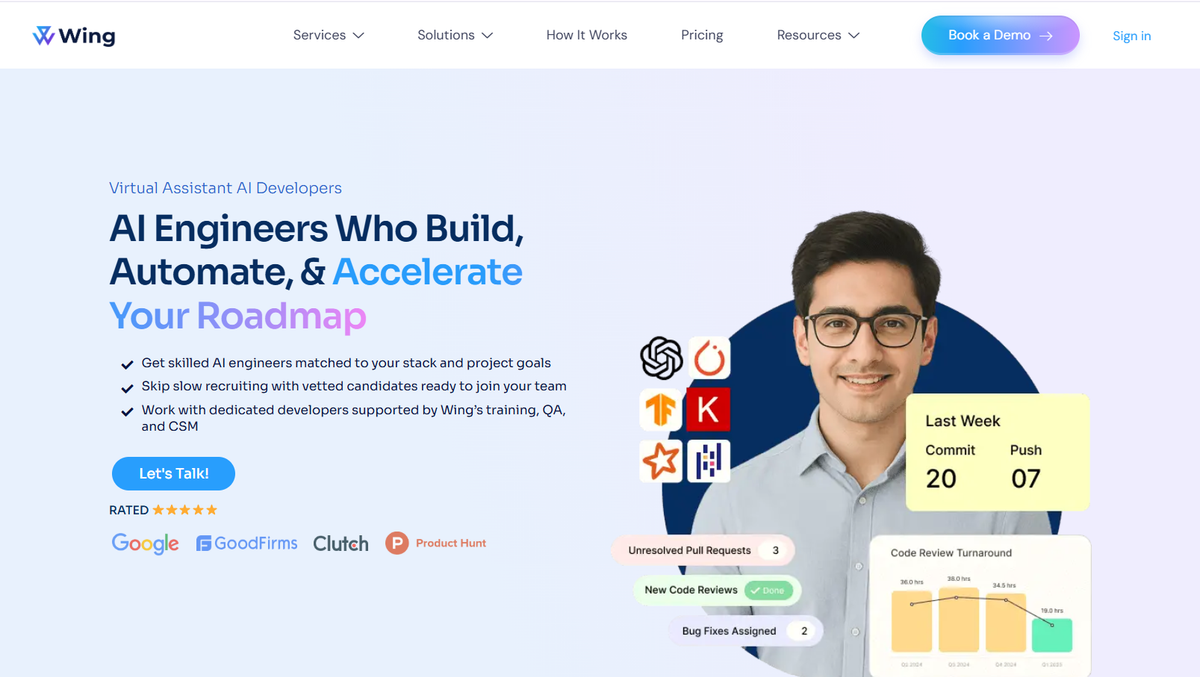
Wing Assistant reviews millions of applications a year through its global talent network. Giving it access to a broad pool of AI developers, ML engineers, and specialists in nine categories:
- Including custom AI development,
- Generative AI,
- LLM fine-tuning,
- Computer vision.
Rather than a self-serve marketplace, the process is handled by a dedicated team. You describe the project and stack; Wing sources and pre-screens qualified candidates from its existing pool or a new search. Then, you still get to talk with prospects directly before deciding who joins your team.
Every hire is backed by Wing’s own training, QA, and a dedicated customer success manager. It also includes a 7-day trial period to confirm fit before committing further. Wing Assistant has a 4.7 rating on Capterra and lists clients including Wolters Kluwer, RingCentral, DoorDash, and Compass.
Wing serves clients across 88 countries and lists 155 roles across 27 industries. The difference from a marketplace shows up in the contracting. Wing holds AICPA SOC and ISO 27001 certifications and will put an MSA, an NDA, and custom talent policies in place upon request. For an AI developer who is going to get repo access and touch training data, that framework is usually the thing that stalls a contractor hire for weeks.
Teams that want to hire AI developers without running a freelance marketplace themselves are the intended fit for this managed model. It is where sourcing, vetting, and ongoing support are handled by the platform rather than the hiring manager.
2. Toptal
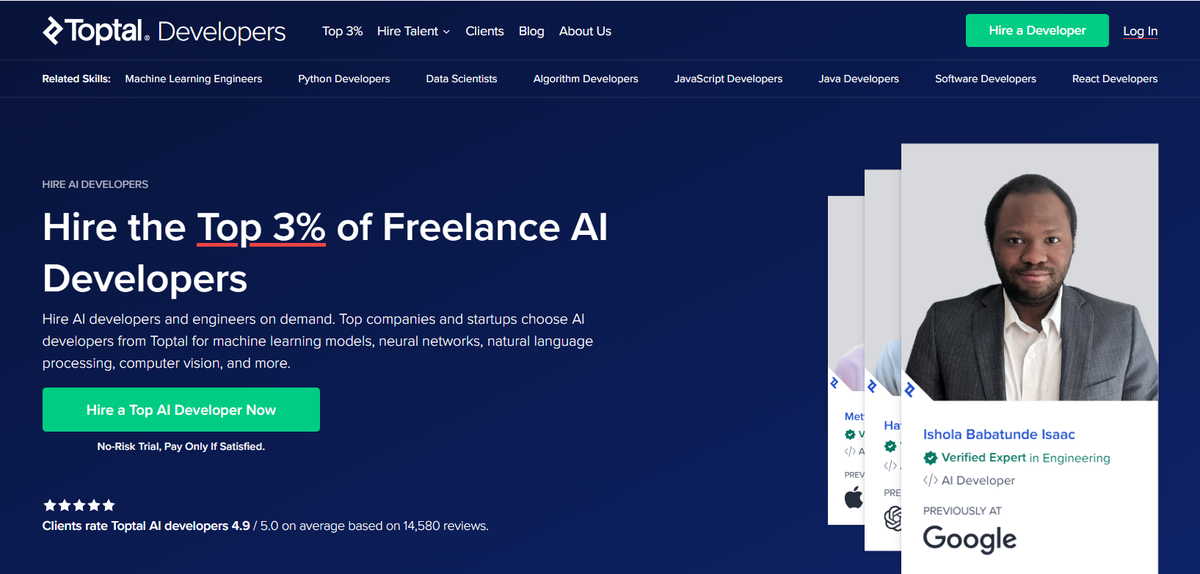
Toptal runs one of the more established vetted-freelancer networks. It accepts only about the top 3 percent of applicants who go through a four-stage screening process. They include language assessment, a timed coding challenge, and a live technical interview.
The company states its average time to match a client with an AI developer is under 48 hours. It is backed by a no-risk trial period and what it reports as a 98 percent trial-to-hire rate.
Engagement is flexible, with hourly, part-time, or full-time options and the ability to scale a team up or down without a long-term commitment.
Access requires a recurring platform fee in addition to the developer’s hourly rate. Toptal does not publish a combined rate card.
The total cost is only clear once a specific engagement is scoped.
3. Turing
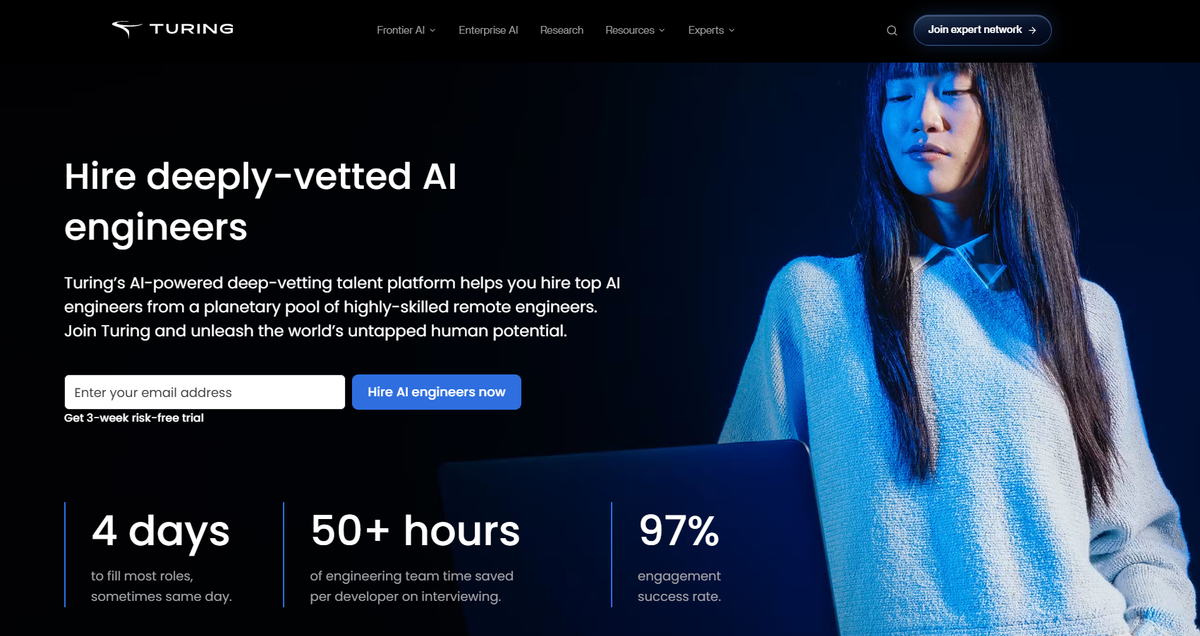
Turing positions itself as an AI-powered talent-matching platform, drawing from a developer pool it states exceeds 3 million people across more than 150 countries. Candidates go through several hours of skills testing and interviews before joining. The company reports roughly a 1 percent acceptance rate. Clients typically receive a shortlist within three to five business days.
Turing bundles the developer’s pay, vetting, matching, and its own service margin into a single hourly rate. That is instead of publishing separate line items.
The specific split between developer compensation and the platform fee is not disclosed upfront. A two-week trial period is included, and the company does not require a minimum contract length to get started.
4. Arc.dev
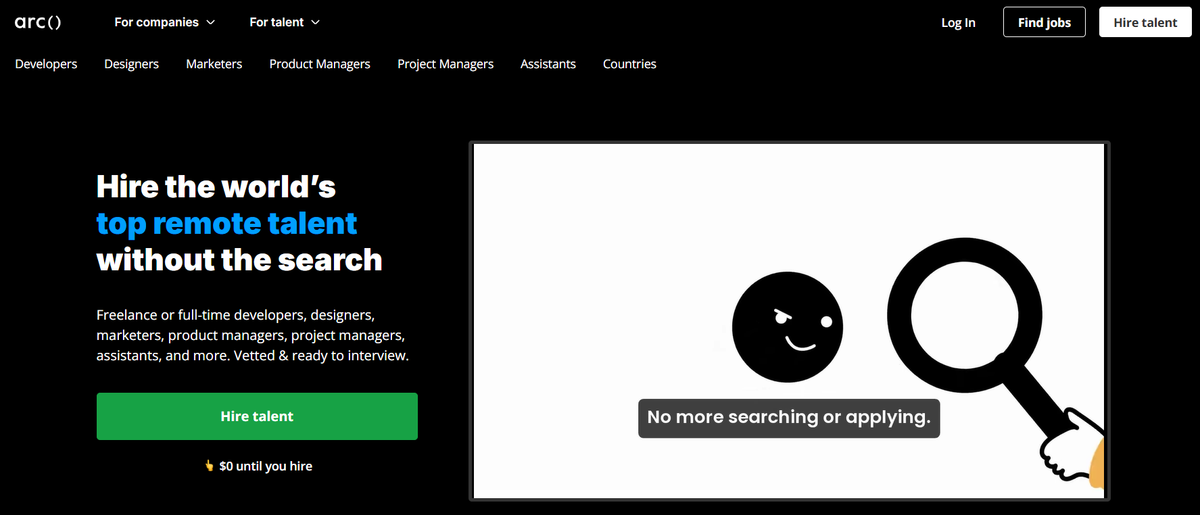
Arc.dev runs a global marketplace built around HireAI, its GPT-4-powered matching tool. It draws from a stated network of roughly 450,000 developers, designers, and marketers across 190 countries. It includes a dedicated AI developer, a data scientist, and machine learning specializations listed separately.
The company reports a vetting acceptance rate in the low single digits. It requires candidates to pass a profile screening, a behavioral interview, and a technical or pair-programming interview.
Arc.dev supports both freelance hourly contracts and full-time permanent placements through the same platform. It makes it a reasonable option for a team still deciding which engagement model it actually wants.
A two-week risk-free trial is included. The company states its model can save clients up to 58 percent compared to traditional hiring. Though this figure comes from Arc.dev’s own reporting rather than independent verification.
Which Platform to Hire an AI Developer Fits Your Situation
- A team that wants a dedicated AI developer integrated into daily standups, without having to manage a freelance marketplace or negotiate rates directly, is generally better matched to Wing Assistant’s managed model. That is where the platform handles sourcing, vetting, and ongoing support rather than the hiring manager. This tends to suit small and mid-sized teams that want a hire to feel like a real team member rather than a rotating contractor.
- A founder or engineering lead who wants direct control over selecting from a shortlist of elite. They individually vet freelancers and are comfortable paying a premium for that certainty, which aligns most closely with Toptal’s model.
- Turing suits a similar profile but on a larger scale, where a team needs to fill several AI or ML roles quickly from a much larger talent pool rather than carefully sourcing a single specialist.
- A team still deciding between a short-term contractor and a full-time hire is best served by Arc.dev, since it is the only platform here built specifically to let that decision be made after the engagement starts, rather than before.
None of these are wrong choices in isolation. The mismatch occurs when a team makes a pick based on brand recognition alone rather than on which engagement model actually fits how they plan to work with the hire.
What Matters When Comparing Platforms to Hire an AI Developer
The vetting acceptance rate gets cited constantly, but it says less than it seems about fit for a specific project. A platform that accepts the top 1 percent of applicants across all engineering disciplines is not the same as one with deep, specific AI and ML vetting.
It is worth asking directly how a platform’s screening process differs for AI-specific roles versus general software development.
Pricing opacity is close to universal here and worth planning around rather than shopping for. Toptal, Turing, and Arc.dev all fold the developer’s pay into a blended rate and manage provider scope per engagement. No platform on this list gives you a firm number without a conversation. So budget for that step rather than expecting a rate card.
The question that actually separates them is what you are buying alongside the developer.
- A marketplace sells access to a vetted individual and stops there.
- A managed model sells the hire plus the scaffolding around it, meaning training, QA, a named account contact, and a contractual framework already in place. The sticker comparison between the two is not like-for-like.
Access is the third question, and it’s often skipped.
An AI developer usually needs repo access, environment credentials, and visibility into your training data within the first week. It’s best to ask what security posture underpins the hire before the shortlist rather than after.
The same instinct applies to AI agents in production, where the demo is the easy part and governance takes months.
This same logic applies well beyond hiring one specialist: the right tech tools or specialized help generally free up time that a small team would otherwise spend covering every function itself.
Conclusion: Finding the Best Platforms to Hire an AI Developer
There is no single best platform for hiring an AI developer, since the right choice depends on:
- How much oversight you want to keep yourself.
- How much access the developer will need to your codebase and data..
- Whether you are hiring one specialist or building out a broader team.
Wing Assistant offers a managed hiring process with dedicated support built in.
Toptal and Turing both lean toward premium, rigorously vetted freelance talent at a bundled rate.
Arc.dev offers the most flexibility to transition between freelance and full-time engagements on the same platform.
Matching the platform’s actual model, not just its vetting statistics, to how your team plans to work with the hire tends to produce a better outcome than choosing based on acceptance rate alone.
Have you hired an AI developer (or an AI-powered VA) for your blog or small business? Tell me which platform you used and what you’d do differently in the comments below. 👇
Frequently Asked Questions
This varies by platform, ranging from under 48 hours on some vetted marketplaces to several business days on others, depending on how specialized the role is and how deep the platform’s existing talent pool runs for that specific skill set.
Most bundle the developer’s compensation together with vetting, matching, and platform support into a single rate rather than itemizing each cost, and managed providers scope per engagement. Expect to request a quote from each platform against the same brief, then compare what is included around the hire rather than the headline number alone.
It depends on how much day-to-day oversight you want. A freelance marketplace generally gives more direct control over the working relationship, while a managed model typically includes more built-in support, training, and account management around the hire.
Ask specifically how the vetting process differs for AI and machine learning roles compared with general software development, since a broad engineering acceptance rate does not necessarily reflect the depth of AI-specific screening.
Disclosure: This Inspire To Thrive blog post contains affiliate links. I may earn a commission from qualifying purchases at no extra cost to you. Some sections were drafted with AI tools and carefully reviewed/edited by me.

- Instagram DM Encryption Is Gone: What It Means for Privacy in 2026 - October 23, 2026
- Best Instagram Story Viewers in 2026: Free Tools + Honest Limits - October 22, 2026
- Which Instagram Monitoring App Wins? EyeZy vs Peekviewer - October 20, 2026
Enjoy this content? Help me show up more often in Google by adding Inspire To Thrive as a Preferred Source: