
For years, SEO was mostly about what happened on your own website. But today the big switch in SEO is on.
You chose the right keywords.
You added plenty of useful content.
You improved the page titles, headings and links.
You made the website faster and easier for Google to crawl.
Then you found other websites willing to link back to you.
All of that still matters. Technical SEO, good content and strong links have not suddenly become useless.
But something important has changed.
Google, AI search engines and potential customers are paying much more attention to what other people say about your business.
And that is creating a big switch in SEO.
Estimated reading time: 8 minutes
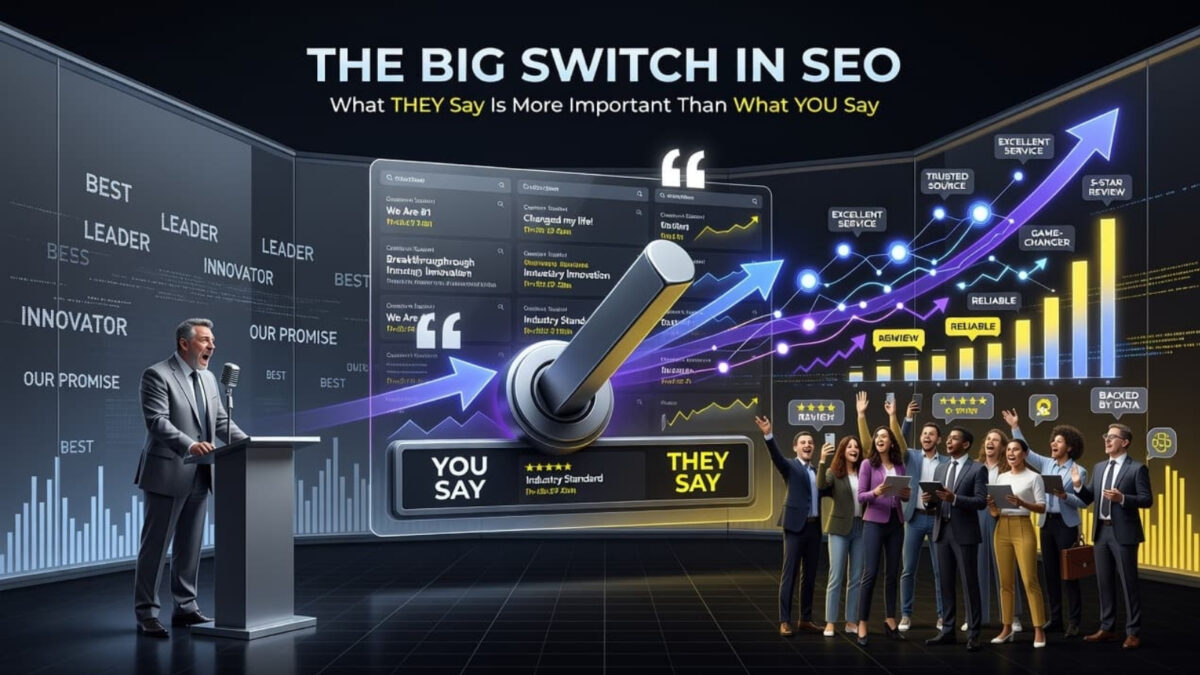
Table of Contents
Anyone Can Say They Are The Best
Most business websites say roughly the same things:
- We provide great service.
- We have experienced staff.
- We offer competitive prices.
- We care about our customers.
- We are one of the leading businesses in our area.
There is nothing wrong with saying these things.
The problem is that anyone can say them.
You can write “Best Building Inspector near me” across the top of your website. But that does not make it true.
Do your customers describe you as trustworthy?
Do local websites mention your business?
Where is the evidence?
Do industry organizations recognize you?
Are people discussing your brand on social media, forums, or community websites?
Are you included in useful directories?
Do other businesses recommend you?
👉 That outside evidence is becoming much more important.
Search is starting to behave more like a person
Imagine you were looking for a plumber.
You visit one plumber’s website and read:
“We are the best solar panel installers in town.”
Would you simply believe it?
Probably not.
You would look at their Google reviews. You might check Facebook, ask a neighbor, or search for the company’s name.
You would want to know what other people say.
Google and AI search tools are trying to do something similar.
They do not want to rely solely on a business’s claims about itself. They look across different sources to understand whether the business is real, trusted, and well-known.
Google’s own guidance emphasizes rewarding content that is helpful, reliable, and grounded in real experience. Its AI systems can also examine a range of sources before producing an answer.
In simple terms, search engines are looking for supporting evidence.
Your website is your sales pitch
Your website tells search engines who you are, what you do and where you work.
That information is still essential.
But your website is also your own sales pitch.
Reviews, independent articles, directory listings, social conversations and recommendations provide another side of the story.
They help confirm—or question—the claims made on your website.
If your website says you provide excellent service and 150 customers say the same, that is strong evidence.
If your website says you are a leading local electrician, and you are also mentioned by local organizations, trade websites, news sites, and community groups, the claim becomes more believable.
But if your website says you are an established local expert and nobody else online appears to have heard of you, there is a gap.
That gap matters.
Welcome to “Word-of-Mouth SEO” in the Big Switch in SEO
Traditional word of mouth happens when one person recommends a business to another.
Online word of mouth leaves clues that search engines can find.
These clues might include:
- Detailed customer reviews.
- Mentions in local news stories.
- Recommendations in public Facebook groups.
- Discussions on Reddit and online forums.
- Listings on trusted directories.
- Membership of industry organizations.
- Supplier or partner pages.
- Sponsorships of local clubs and events.
- Podcasts, videos and interviews.
- “Best of” articles and comparison pages.
- Social posts that mention the business.
Not every mention needs to include a clickable link.
This shift is at the heart of the big switch in SEO.
A clear mention of your business name can still help people, and potentially search systems, connect your brand with a service, product or location.
For example, if your company is regularly mentioned alongside “skilled blogger for businesses”, it helps build a wider picture of what your business is known for.
The internet begins to join the dots.
Reviews are becoming a business asset
Reviews used to be treated mainly as something that helped people decide whether to call.
They still do that, of course.
But reviews also provide search engines and AI tools with detailed information about a business.
A review that says:
“Good Oil Marketing, very good.”
is positive, but it does not explain very much.
A review that says:
“Corey and his team from Good Oil Marketing in New Zealand rebuilt our website and increased our traffic by 300%, and our clicks by 500%, in 12 months”
contains much more useful information.
It mentions the service, location, customer type, and experience.
Over time, genuine reviews can create a detailed picture of what a business does well. They use the language real customers use, not the polished language written by a marketing team.
That makes them incredibly useful.
How AI Search Pushed the Big Switch in SEO
People are no longer only typing short searches such as:
plumber Portland
They are asking longer questions:
Who is a reliable plumber in Portland for an urgent leak?
Or:
Which local electrician has good reviews for older homes?
AI search tools often try to give a direct recommendation or a short list.
To do that confidently, they need evidence.
A tidy website can explain that you offer a service. But independent reviews and mentions help show that you are genuinely known for it.
This does not mean an AI tool counts every mention and automatically puts the business with the most mentions at number one.
It is more complicated than that.
👉 But a business with a clear website, strong reviews, consistent information, and genuine third-party mentions gives search systems much more to work with.
Your brand matters more than it used to
In the past, a small business could sometimes rank well by creating one heavily optimized page and building a few links to it.
Today, search engines are becoming better at understanding businesses as complete brands.
They can look at:
- What the business is called.
- What services it provides.
- Where it operates.
- Who is connected to it.
- How long it has existed.
- Where it is mentioned.
- What customers think about it.
- Whether information about it is consistent.
This is why brand building and SEO are starting to overlap.
A local sponsorship may look like a branding activity.
A customer review may look like a reputation activity.
An interview in a trade publication may look like PR.
A helpful YouTube video may look like social media marketing.
But all of these activities can also strengthen the online evidence around your business.
Technical SEO is still the foundation
This is not an excuse to ignore your website.
If Google cannot crawl your pages, understand your services or work out where you operate, outside mentions will not magically solve everything.
You still need:
- A fast, mobile-friendly website.
- Clear service pages.
- Accurate contact and location details.
- Helpful original content.
- Sensible titles and headings.
- Internal links.
- Pages that answer real customer questions.
Think of this as the foundation of the house.
What other people say about you is the proof that the house is worth visiting.
You need both.
So, What Should a Business Do Now?
These steps help you adapt to the big switch in SEO rather than fight it.
Start by looking beyond your own website.

Ask happy customers for honest, detailed reviews.
Make sure your business information is correct across Google, Bing, Apple, and other relevant directories to ensure reputation signals are accurate.
Build real relationships with local organizations, industry groups, suppliers and community websites.
Create useful stories, information or research that other people may want to discuss.
Take part in public online conversations where your experience is genuinely helpful.
Look for opportunities to be interviewed, featured, listed or recommended for third-party mentions.
Most importantly, give people an experience worth talking about.
You cannot manufacture a strong reputation forever. Sooner or later, the real customer experience catches up with the marketing.
Conclusion: The Big Switch in SEO
The old version of SEO asked:
“What should we put on our website?”
The newer version asks:
“What evidence exists across the internet that we are as good as we claim?”
That is the big switch.
What you say still matters. Your website needs to clearly explain your business.
But what others say about your business- your customers, your community, industry websites, publishers, and other trusted voices is becoming harder to ignore.
SEO is no longer only about optimizing pages.
It is also about building a business that people know, trust, mention and recommend.
In other words, the future of SEO may look a lot like the oldest form of marketing there is:
👉 A good reputation, traveling from one person to another.
Further reading: Google’s guide to helpful, reliable content and Google’s guidance for appearing in AI search features.
Disclosure: This Inspire To Thrive blog post contains affiliate links. I may earn a commission from qualifying purchases at no extra cost to you. Some sections were drafted with AI tools and carefully reviewed/edited by me.

Enjoy this content? Help me show up more often in Google by adding Inspire To Thrive as a Preferred Source:



Hey Corey (thanks Lisa for opening up comments) Another gr8 article. I read the last post you did for Anthony G. also a top-notch article!
Anyone Can Say They Are The Best.
Yes!
But nothing beats having other people say you are the best…
But we mustn’t forget, a good review does a whole lotta good. But if a person runs you or your business down, whether rightly or wrongly. This is the world we live in.
Trevor
Indeed – things are always changing online.
Hi Corey,
Super keen observation here.
Google is behaving more like a person not a search engine. AI fostered this “thinking” because long tail queries place the emphasis on specificity, plus reviews, or endorsements, or positive brand mentions.
Anyone can brag. But you need to be truly helpful to influence others to trust and vouch for your content, let alone professional products and services. I can claim I am the best. The court of public opinion decides what is true and what is not true. The ball really is in their court so help ’em, bond and let them decide. Organic referrals grow as you serve, listen and care.
As always, create practical content and build bonds with resonant readers. Set the table for referrals.
But as you noted it makes sense to honor technical SEO because the algorithm still values the basics.
Excellent post.
Yep – you are correct (as usual). Technical SEO isn’t a problem until it IS. Making good content will never be a bad play!