
SEO strategies, or Search Engine Optimization, have come a long way since their early days. What once revolved around keyword stuffing and link chasing has become a more sophisticated practice centered on helpful content, strong technical foundations, user experience, and visibility in both traditional search results and AI-generated answers.
In 2026, ranking still matters, but being cited in AI Overviews and AI Mode often matters just as much (or more). Understanding how we got here helps you focus on the strategies that actually drive results today.
Estimated reading time: 6 minutes
Table of Contents
Understanding SEO: A Brief Overview
At its core, SEO is the practice of improving your website’s visibility in search engines so the right people can find you. The goal remains the same: attract qualified traffic that converts. The methods, however, have changed significantly.
Modern SEO covers on-page optimization, technical health, content quality, authority signals, and increasingly, how well your content can be understood and cited by AI systems.

The Early Days: Keyword Stuffing and Metadata
In the late 1990s and early 2000s, SEO was largely a numbers game. Website owners stuffed keywords into content, meta tags, and even hidden text. Meta titles and descriptions carried heavy weight, and many tactics that would get you penalized today were common practice.
Search engines eventually got smarter. Google began rewarding relevance and quality over pure keyword density, marking the end of the pure “stuffing” era.
The Rise of Content Marketing
As black-hat tactics lost effectiveness, content quality became increasingly important. Businesses shifted toward creating useful, informative content that answered real questions. Blog posts, guides, videos, and resources became central to SEO strategies.
This shift still holds. High-quality content that demonstrates experience and expertise remains one of the strongest ranking and citation signals.
Mobile Optimization Became Non-Negotiable
The explosion in smartphone adoption forced a major change. Google moved to mobile-first indexing, and sites that performed poorly on phones lost ground. Responsive design, fast load times, and mobile-friendly formatting became table stakes.
That requirement hasn’t gone away; it has only become more important as Core Web Vitals and page experience continue to influence rankings and user behavior.
As smartphones became ubiquitous, mobile optimization became a critical aspect of SEO. As more users access the internet on mobile devices, search engines have begun prioritizing mobile-friendly websites in their rankings.
Voice Search and Conversational Queries
Voice assistants pushed search toward more natural, long-tail, question-based queries. This encouraged content written in a conversational style that matches how people actually speak and ask questions.
Today that same principle applies to AI search experiences, where users often ask longer, more detailed questions.
User Experience Moved Center Stage
Google has repeatedly emphasized that good user experience supports better rankings. Clear navigation, fast pages, readable layouts, and helpful content all contribute.
Sites that frustrate users tend to underperform over time.
Artificial Intelligence Transforms Search
AI has been part of Google’s systems for years (RankBrain, BERT, and later models). The bigger shift came with generative AI features:
- AI Overviews — AI-generated summaries that appear at the top of many search results.
- AI Mode — A more conversational, multi-turn search experience.
These features often answer questions directly on the results page, reducing clicks to websites (zero-click searches). When your content is cited as a source in an AI Overview or AI Mode response, you still gain visibility and brand exposure, even if the click-through rate is lower than traditional blue-link results.
Google has been clear that optimizing for these generative AI features is still SEO. The same foundations matter: helpful, original content; strong technical SEO; clear structure; and demonstrated experience, expertise, authority, and trust (E-E-A-T).
Local SEO Grows in Importance
For businesses serving specific geographic areas, local SEO remains highly effective. Optimized Google Business Profiles, consistent citations, reviews, and location-relevant content help you appear in the local pack and in AI-generated local recommendations.
Technical SEO Strategies as the Foundation
Technical SEO often works behind the scenes, but it is critical. Search engines and AI systems need to crawl, render, and understand your pages. Key areas include:
- Site speed and Core Web Vitals.
- Clean site architecture and internal linking.
- Proper indexing and crawlability.
- Structured data where it adds clarity.
- Mobile performance.
Without a solid technical base, even excellent content struggles to perform.
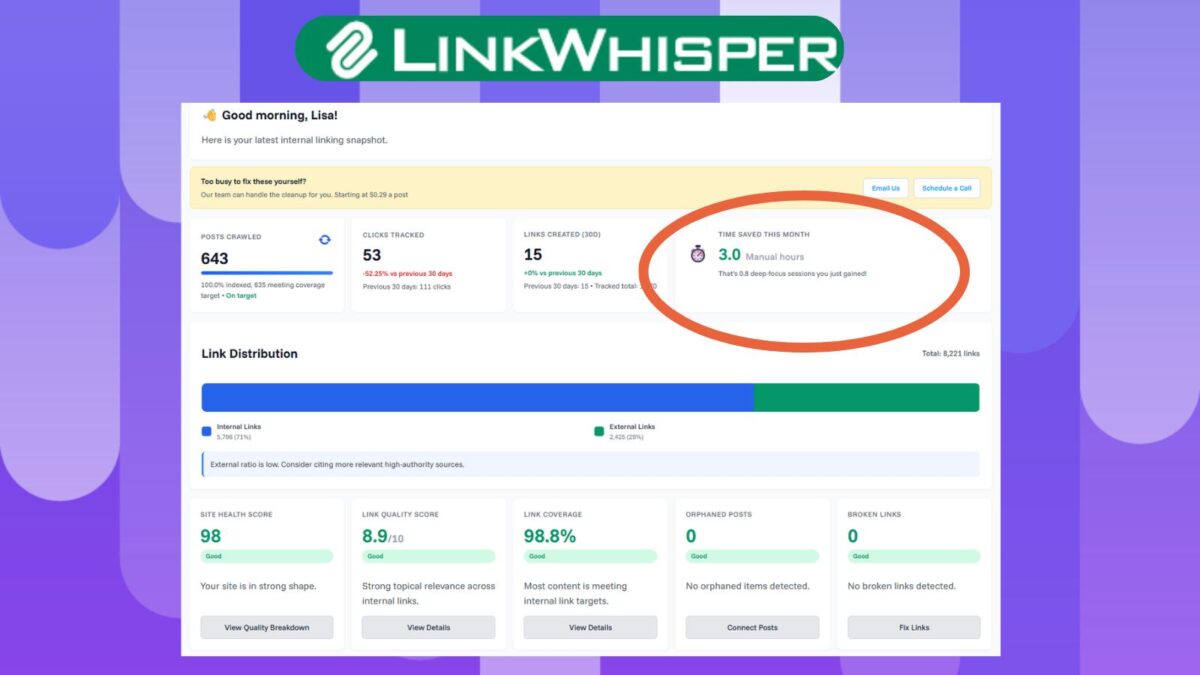
For internal linking, I use Link Whisper. It automatically suggests relevant links within your content, which saves time and improves how search engines crawl and understand your site structure; especially useful as you update older posts.
Data and Measurement Still Matter
Tools like Google Search Console and Google Analytics remain essential. In 2026, Search Console also provides insights into visibility in generative AI features. Tracking which pages get impressions in AI Overviews and AI Mode helps you understand the new visibility landscape.
As AI Overviews and AI Mode become a bigger part of search, one of the most useful things you can do is track whether your content is actually appearing in them. Here’s a quick step-by-step walkthrough video below showing how to set this up in GA4 so you can see AI referral traffic:
Want to go one step further? Google isn’t the only place showing AI answers. Microsoft’s tools also let you see when your content is being cited.
In this follow-up video, I show how to track AI citations and grounding queries for free inside Bing Webmaster Tools:
→ How to Track AI Citations & Grounding Queries in Bing Webmaster Tools
Together, these two free methods give you a clearer picture of your visibility in both Google AI Overviews and other AI search experiences.
What Works in SEO in 2026
The strategies that consistently perform today include:
- Creating original, helpful content that demonstrates real experience.
- Making content easy for both people and AI systems to understand (clear headings, direct answers, logical structure).
- Maintaining strong technical health.
- Building genuine authority and trust signals.
- Optimizing for local search when relevant.
- Monitoring both traditional rankings and AI visibility.
- Focusing on the full user journey rather than just rankings.
Tactics that no longer carry the weight they once did (or that Google has explicitly said are unnecessary for generative AI features) include keyword stuffing, pure volume-based content, and many of the “special AI optimization” hacks that circulate online.
Looking Ahead
SEO will keep evolving. AI features will become more common, personalization will increase, and the line between traditional search and generative answers will continue to blur. The constants remain: create content that genuinely helps people, keep your site technically sound, and stay focused on experience and trust.
The businesses and creators who treat SEO as an ongoing practice of delivering value, rather than a set of tricks, will continue to do well.
What part of SEO are you focusing on most right now? Drop a comment below;👇 I’d love to hear what’s working (or not working) for you in 2026.
Disclosure: This Inspire To Thrive blog post contains affiliate links. I may earn a commission from qualifying purchases at no extra cost to you. Some sections were drafted with AI tools and carefully reviewed/edited by me.

- Find Broken Links on Site Fast: Scan, Fix, and Protect Your SEO - October 15, 2026
- 8 Best AI Ranking & Visibility Tracking Tools for Bloggers (2026) - October 15, 2026
- Link Whisper Review: Best Plugin To Boost Your Internal Links - October 14, 2026
Enjoy this content? Help me show up more often in Google by adding Inspire To Thrive as a Preferred Source:



Far and away Lisa, publishing original, helpful content is the most difficult and most reliable aspect of SEO now just it’s been for a long time. As you noted, this still holds. But sometimes the blogging world chases lesser factors and ignores this core vital.
Sometimes I miss the bus in optimizing terms but hold position one. I did it since 2014 for “successful bloggers to follow”. I updated the post once over the past 12 years. Why does it hold position one for such a long time?
I gave full attention to writing a complete resource. I imagined the most successful bloggers to follow based on my personal experience. I relayed my knowledge via a detailed, practical blog post listing and explaining why these are the best bloggers to study if you want to become a successful blogger yourself.
I didn’t optimize the post. Yet Google believes it to be the best answer since 2014. Even more interesting? Other page 1 results use money as a successful qualifier. I know why. Yet the Google algorithm respects my perspective of those who publish truly helpful content as being the best bloggers to follow.
You’re so right, Ryan. Original, helpful content is still what matters most in SEO—even when keywords and plugins get all the attention.
Your “successful bloggers to follow” post is a perfect example. You didn’t just list popular names; you used your own experience to define success and explained why those bloggers are worth studying. That clear point of view is why it still holds position one after all these years.
Google looks for pages that fully answer the real question behind a search. Your post does that from a blogger’s perspective, not just another income-focused list.
This is exactly why I tell readers at Inspire To Thrive to write for people first and optimize second. SEO helps people find your content, but helpful content is what keeps them coming back.
Readers still want a useful answer from someone who knows the subject. Your post proves that focusing on that first is still one of the best SEO lessons around.
Great points. I have been a family lifestyle blogger for 14 years and everything evolves but I agree that SEO strategy is changing at a particularly fast rate. I also agree that making sure you have the best, most useful content is key to staying on top.
Hi Scarlet, welcome to Inspire To Thrive. It really is evolving at an extremely fast pace! I was offline most of the day and saw already new things that happened today. I’m glad you agree on the useful content. Have a great day and thanks for coming by on this one.