
In 2026, with rising ad costs and algorithm changes on platforms like Instagram, Pinterest, and Google, focusing on CLV is more critical than ever for solopreneurs and small businesses. A healthy CLV: CAC ratio (ideally 3:1 or higher) helps you sustain growth without burning through marketing budgets, especially as many shift toward affiliate and sponsorship models.
Estimated reading time: 8 minutes
Let’s see why CLV is a crucial business metric, how to measure it, and how to improve it.
Table of Contents
What Is The Value Of A Lifetime Customer?
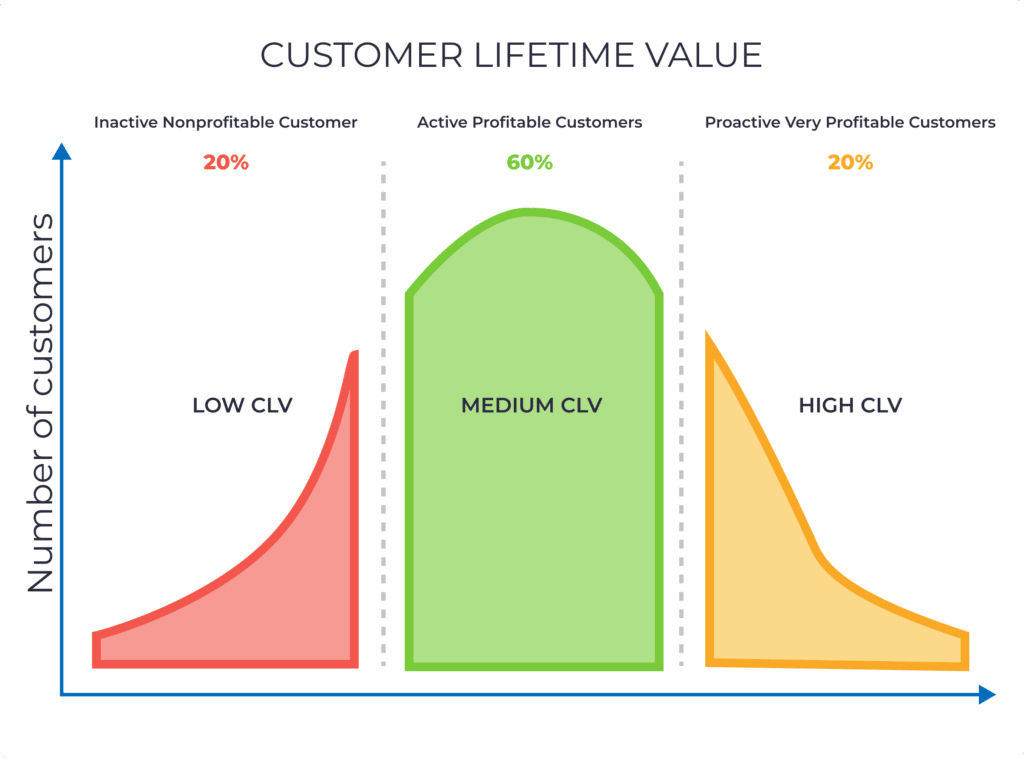
Customer lifetime value is the revenue you generate from a particular customer over the course of your relationship. It’s a critical metric for business growth, as it includes all orders from a specific customer, indicating product-market fit and brand loyalty.
The value of the customer lifetime metric can give you insight into your buyers’ interactions with your brand and the effectiveness of your marketing, sales, and SEO strategies.
It can be an excellent foundation for your market segmentation strategy and is essential for enhancing your marketing strategy.
You can use it to segment your target audience according to their shopping behavior. Then, tailor your content, products, and services to improve their experiences with your brand.
Benefits of Measuring Your CLV
The most notable benefits of measuring the value of the customer’s lifetime include:
- Better customer retention: Tracking your CLV and improving market segmentation can help you determine what works and what might need an adjustment. You’ll understand your customers’ purchasing habits to personalize their experience, retain them, and inspire loyalty;
- Higher profitability: Your CLV can help you identify high-value customers and top-selling products or services. You’ll know how to keep clients, encourage them to spend more, and attract similar consumers;
- Repeat sales: The CLV metric shows how many times someone has purchased from you in a year or over their customer lifetime to help you make strategic decisions for repeat business;
- Data-driven forecasting: Once you know the revenue each customer brings, you can adjust your CAC to avoid over- or under-spending. Adding behavioral data to predictive CLV models can also help you reduce CAC and improve future planning.
How To Calculate Your CLV
The formula for calculating your customer lifetime value is as follows:
CLV = Average Order Value x Number of Orders x Retention Period.
For instance, let’s say a customer has visited your e-commerce shop approximately 5 times per year for 7 years, with an average order value of $50. Multiplying those numbers would give you a CLV of $1,750, the total revenue one customer has generated for your business.
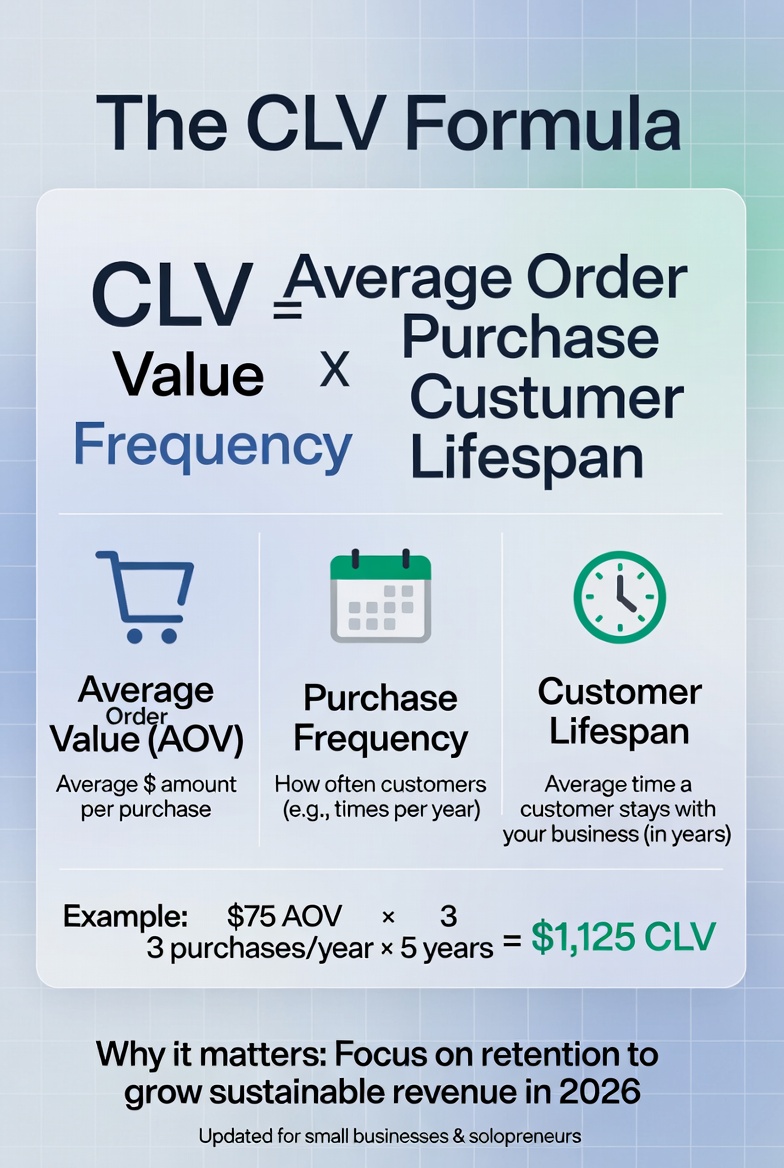
A higher CLV means more loyal customers who make repeat purchases and can get you more referrals.
Did you know that a favorable customer CLV is at least 3 times your CAC? For instance, if your marketing spending to acquire a particular customer is $100, you should generate at least $300 from that customer’s purchases during their relationship with your brand.
How To Increase Your Customer Lifetime Value
Retaining customers still costs 5-7x less than acquiring new ones; a 5% retention boost can increase profits 25- 95%, according to Rivo’s most recent statistics.
Therefore, increasing your CLV is critical for long-term business growth, and here are the best practices to follow:
- Onboarding & Experience: Add mobile-first AI chatbots and personalized welcome sequences.
- Relationships: Emphasize email marketing + social (Instagram Reels/Collections, Pinterest for traffic).
- AOV & Repeat Purchases: Upselling/cross-selling, bundles, reorder reminders.
- Loyalty Programs: Points, tiers, VIP perks, mention simple implementations for small biz.
- Customer Support: Expand on AI tools + personal touch.
Improve Customer Onboarding
Customer onboarding is the nurturing process that sets the tone for every new relationship and compels buyers to return.
Always provide immediate value from initial interactions and welcome emails to follow-up emails and product walkthroughs. Incentivize customers to return by being straightforward and transparent, and building relationships and trust.
Provide A Seamless Buying Experience
A frictionless buying experience leads to more conversions, sales, and repeat purchases. Thus increasing the formula for your customer’s lifetime value.
That means fewer form fields, transparent shipping costs before checkout, and multiple payment options. As well as accurate product descriptions, a smooth checkout, and a stress-free product return process.
Build Meaningful Relationships
Email and social media marketing are the keys to better customer relationships. You can use email for nurturing and social channels to interact daily with consumers and turn them into brand ambassadors. Social networks are also perfect for driving more organic website traffic.
Monitor social media mentions to see what people say about your brand and understand how to address their needs, pain points, interests, and preferences.
Increase Average Order Value
Upselling and cross-selling strategies can help you entice customers to spend more. Complementary products or services work like a charm, but product bundles also can do the trick.
However, the key is to compel consumers to increase their order value by offering a high-end deal. It could be a more expensive product or service that offers greater value, multiple products at a discount, or several items that go together perfectly. You can also offer freebies on orders over a specific value.
For example, at Inspire To Thrive, I add on Google My Business services to social media management services.
Encourage Repeat Purchases
If you offer SaaS products, streaming services, and other monthly or annual memberships, you can encourage repeat purchases to drive each customer’s lifetime value.
Otherwise, you can email reorder reminders and offer discounts, coupons, and vouchers for saving on your next purchase.
Offer Loyalty Programs
A loyalty program can boost sales and revenue, retain customers, and attract new clients. Who doesn’t like earning points on every purchase to save on future orders or snatch excellent rewards?
Rewarding loyal customers is an effective way to drive repeat sales and increase their lifetime value.
Provide Exceptional Customer Support
Email, phone, and live chat support are paramount for better customer experiences and relationships.
Having a responsive, professional, and helpful support team will help you build trust, credibility, reputation, and long-term loyalty. Using a WhatsApp AI chatbot helps your team handle routine questions instantly, improving response times and allowing staff to focus on more complex customer needs.
This is one of the key factors in the formula for customer lifetime value.
Conclusion: Formula for Customer Lifetime Value
Increasing your customer lifetime value is essential for business growth. That is because a higher CLV equals more revenue. And more revenue means your marketing and sales strategies work.
Measuring this metric will help you boost customer retention, satisfaction, and loyalty. Therefore, shooting your profits through the roof.
Finally, what is your formula for customer lifetime value? I’d love to hear about it in the comments below.
Frequently Asked Questions About The Formula for Customer Lifetime Value
The simplest customer lifetime value formula is:
CLV = average purchase value x purchase frequency x customer lifespan
That gives you a revenue-based estimate of what a customer is worth over time. If you want a profit-based CLV, subtract the cost to serve or acquire that customer first, since revenue alone can make the number look better than it really is.
For a service business, start with the average amount a client pays per project, retainer, or month. Then multiply that by how often they buy and how long they typically stay with you. If you offer recurring services, such as SEO, social media management, or maintenance plans, this formula can get pretty close to the actual number.
You need a few core data points: average order value, purchase frequency, and customer lifespan. If you want a more accurate version, add gross margin, churn rate, and customer acquisition cost. The better your data, the more useful the CLV calculation becomes for pricing, ad spend, and retention decisions.
Yes, and the difference matters. A one-time buyer may have a low CLV unless they come back or refer others, while a repeat customer can be worth far more than their first purchase suggests. That’s why businesses that rely on repeat sales usually watch CLV closely, not just first-order revenue.
Focus on getting customers to buy again, stay longer, or buy more each time. Strong follow-up, useful email sequences, loyalty offers, subscriptions, and better customer service can all increase CLV. If clients see more value after the first sale, they’re more likely to come back, and that’s where the real profit shows up.
Disclosure: This Inspire To Thrive blog post contains affiliate links. I may earn a commission from qualifying purchases at no extra cost to you. Some sections were drafted with AI tools and carefully reviewed/edited by me. The top image was made with AI.

- What’s the Real Secret to Successful Affiliate Marketing? - October 10, 2026
- Why Blogging Websites Need Blogging Networks to Thrive - October 10, 2026
- Mastering a Content Gap Analysis with AI: A Step-by-Step Guide - October 9, 2026
Enjoy this content? Help me show up more often in Google by adding Inspire To Thrive as a Preferred Source:

Hi Lisa,
Improving customer CLTV/CTV is an ideal way to boost revenue. And one of the best ways you noted is to increase the average order value. You can do this through upselling and cross-selling. The idea is to lure consumers into spending more on your products or services. For a service provider, you can upsell and cross-sell other services, but you can also go beyond your client’s expectations and wow him with your services. For instance, I like to impress my clients, especially new customers, and make them regular customers. Recently, I got a new client from England who agreed to pay $400 for a piece of blog content. After submitting the completed draft, he was so pleased that he offered me $200 and asked me to send an invoice of $600. He also booked another gig right away. So going beyond what your client expects of you is another remarkable way to increase CTV.
Thank you for sharing, Lisa
Hi Moss, I like the idea of going beyond expectations! That is a great way to upsell and cross-sell your products or services. Congratulations on your new client paying more for your services. That is awesome. A great way to boost revenues for sure! I appreciate your taking the time to come by and comment on this one. Have a great rest of the week Moss.