If blogging feels like writing into a noisy room, you’re not alone. People skim on phones, jump between tabs, and leave the second a post feels hard to follow. The good news is that the most read blogs aren’t winning because they publish more words. But some blogs are winning today.
They win because reading feels easy, helpful, and worth the time.
This post breaks down what those blogs do differently, in ways you can copy right away. No “rewrite your whole site” advice. Just practical habits you can use on your next draft, your next refresh, and your next weekly post.
You’ll see the reasons readers come back, from faster scanning to stronger trust signals to simple engagement loops that don’t feel salesy.
Estimated reading time: 10 minutes
Table of Contents
Key Takeaways
- Most read blogs succeed by making reading easy, useful, and engaging, rather than by word count.
- They focus on readability with clear structures, short paragraphs, and plain language to keep readers’ attention.
- Delivering real value in each post builds trust and ensures readers return for practical solutions to their problems.
- Creating a consistent voice and predictable posting rhythm helps establish a loyal audience and encourages repeat visits.
- Engaging readers through interaction and quick responses fosters a welcoming community and makes them feel valued.
1. Make it Easy to Read Fast (the Readability Habits Readers Notice First)
The first job of a blog post isn’t to impress. It’s to get read. If your layout feels heavy, readers bounce, and bounce rates don’t just hurt one post. They teach people that your site takes work.
Most read blogs treat readability like a promise: “You’ll find what you need quickly.” That one promise leads to longer time on page, more scroll depth, and more return visits because readers remember the experience, not just the topic.
They use clear structure so readers can scan in 10 seconds
Scanning is not rude, it’s normal. Think of a post like a kitchen recipe. If someone can’t spot the ingredients and steps fast, they won’t cook, and they won’t come back for dinner.
Here’s what readers notice right away:
- Short paragraphs (often 1 to 3 sentences)
- H2s that say what the section is for (not clever, not vague)
- H3s that break big steps into small moves
- Occasional bold on key lines, used like a highlighter, not paint
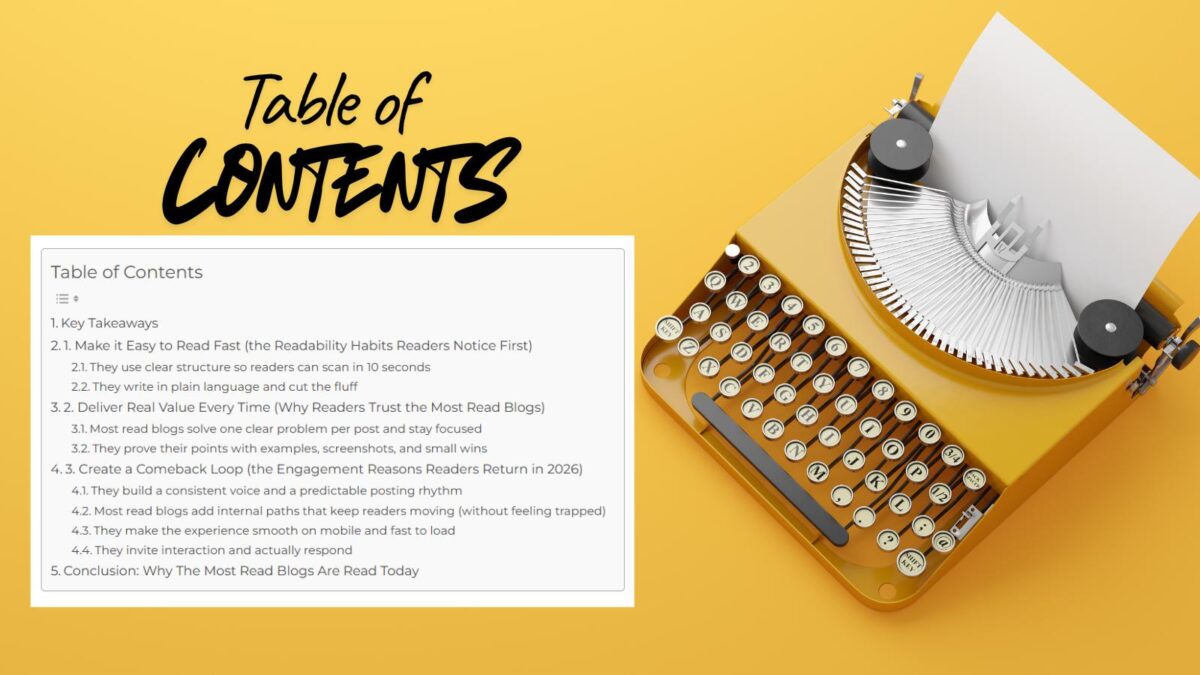
A table of contents can help when a post is long or has many steps (like “How to set up an X bio”). It also makes your post feel organized, which lowers the “this looks like work” reaction.
Quick pre-publish checklist (60 seconds):
- Can someone understand the post by reading only the headings?
- Does each section answer one clear question?
- Are paragraphs under four lines on mobile?
- Did you bold only the lines a skimmer truly needs?
- Is there one obvious next step near the end?
If you do nothing else this week, fix your headings. Headings are the signposts that keep people from wandering off.
They write in plain language and cut the fluff
Busy readers don’t want “smart.” They want it clear. The most read blogs don’t talk down to people, but they also don’t hide simple ideas behind big words.
When a technical term is needed, they define it once, then move on.
A simple editing routine works better than “trying to write better”:
- Remove filler openers (“In today’s post…”)
- Shorten long sentences (split one into two)
- Swap big words for common ones
- Use active voice when it fits (“You can change this setting”)
Before: “Utilizing internal links can facilitate improved user engagement across your website.”
After: “Add 2 to 3 helpful internal links so readers can keep going.”
Plain language does something else, too: it builds trust. Readers feel like you’re a real person, not a brochure. That’s a big reason most read blogs feel friendly even when they teach advanced topics like SEO, analytics, or AI tools.
2. Deliver Real Value Every Time (Why Readers Trust the Most Read Blogs)
A clean blog layout gets the click, but value earns the repeat visit. People return when your posts save them time, reduce confusion, or help them get a quick win.
Value doesn’t have to mean long. It means the reader finishes your post thinking, “That answered my question,” not “I’ll figure it out later.” Trust grows each time you keep that promise.
Most read blogs solve one clear problem per post and stay focused
One post, one primary job. That’s the rule. Readers get frustrated when a headline promises one thing, only for the post to drift into three side topics and a personal history.
A focused post usually has:
- A clear promise in the first few lines (what the reader will get)
- A simple path from problem to fix
- Sections that stay on topic (no bonus detours)
- A close that tells the reader what to do next
If you want a strong hook, don’t start with your life story. Start with the pain point your reader already feels.
Examples of focused promises that work well:
- “By the end of this post, you’ll have a simple weekly content plan.”
- “You’ll learn how to speed up your blog on mobile without tech stress.”
Then, as you write, keep asking one quiet question: “Does this paragraph help the promise?” If not, cut it or save it for another post. That single habit is why most read blogs feel easier to finish, and finished posts are the ones people trust.
End with next steps that match the post. If the post is about faster blog images, end with “compress your top 10 images this week,” not “start a podcast.”
They prove their points with examples, screenshots, and small wins
Readers have seen bold claims for years. Proof is what makes your advice land.
Proof doesn’t have to be fancy. It can be:
- A quick example with real numbers (even small ones)
- A short “what I tried” story (what worked, what didn’t)
- A screenshot of a setting (like cache on/off, image compression level)
- A mini checklist that leads to a small win

This matters because readers don’t just want ideas. They want confidence. A screenshot or simple walkthrough reduces fear of messing up.
Stay honest, too. If results vary, say so in plain words. For example: “This sped up my page by about a second; your results depend on your theme and image size.”
That kind of honesty is a trust builder, and trust is why readers bookmark, subscribe, and come back.
3. Create a Comeback Loop (the Engagement Reasons Readers Return in 2026)
Getting a reader once is hard. Getting them back is a system. In 2026, readers come back when your blog feels familiar, easy on any device, and connected, not just a pile of posts.
A comeback loop is simple: they enjoy one post, find the next one quickly, feel noticed, and then return on their own.
They build a consistent voice and a predictable posting rhythm
Consistency isn’t about posting daily. It’s about being reliable.
Sure! Here’s the updated sentence with a checkmark before it:
✔️ A consistent voice means your reader knows what they’ll get: practical tips, clear steps, and a tone that feels like a helpful guide, not a lecture.
A predictable rhythm helps even more. Pick a schedule you can keep without burning out:
- Weekly, if blogging is a core channel for you
- Biweekly, if you juggle client work or a shop
- Monthly, if each post is a deep tutorial and you promote it well
Quality stays high when you reuse simple tools:
- A repeatable outline (hook, steps, examples, next steps)
- A checklist for formatting and links
- A “series” format (like Social Media Timesavers, SEO Basics, Tool Tutorials)
When readers see a pattern, they trust you’ll show up again. That’s a quiet reason why the most-read blogs keep growing, even when trends shift.
Most read blogs add internal paths that keep readers moving (without feeling trapped)
Readers don’t want a maze. They want a path.
Internal links help when they’re chosen with care, like offering a reader the next chapter rather than dumping a whole library on their feet.
A few options that work well:
Related post links: Add 2 to 4 links that match the exact topic.
“Start here” page: Great for new readers who need the basics first.
Topic hubs: One page that collects your best posts on a theme (Pinterest, Instagram, blogging, SEO).
“Read next” section: A simple suggestion at the end of the post, based on what they just learned.
Use clear anchor text. “Speed up WordPress images” beats “click here.” Also, don’t overlink. If your post looks like a blue confetti cannon, it feels stressful.
Don’t forget about your external broken links; no one wants to click on a 404 message.
They make the experience smooth on mobile and fast to load
Most people will read your post on a phone, even if they buy on a laptop later. If your mobile view is cramped, slow, or pop-up-heavy, they’ll leave, and they might not return.
You don’t need to be a tech pro to improve this. Focus on what readers feel:
- Large enough font
- Enough line spacing
- Images that load fast (compressed, sized right)
- Fewer popups (especially on entry)
2-minute phone self-test:
- Open your newest post on your phone, on cellular data if you can.
- Scroll for 15 seconds. Does anything jump around or block the text?
- Pinch-zoom test, if you need it, the font is too small.
- Tap test: Can you tap links without hitting the wrong one?
- Exit test: Can you close any pop-up with one tap?
If the page feels calm, readers stay longer. Calm is underrated, and it’s a reason many most read blogs outperform louder sites.
I love proofreading my blog posts on my mobile device because I usually catch misspellings in new or updated posts.
They invite interaction and actually respond
A blog isn’t a billboard. It’s a place people return to when they feel welcome.
Most read blogs ask for interaction in ways that feel easy, not pushy. One clear call to action is enough. Try:
- One question at the end (“What’s the hardest part of staying consistent?”)
- A quick opinion prompt (“Team weekly posts or team biweekly?”)
- A request for a reader example (“What headline got your best clicks?”)
Then comes the part many skip: replying.
When you respond to comments, people feel seen. When you mention a reader’s tip in a future post, they become a regular.
Pair that with an email newsletter that highlights your newest post (plus one older helpful link), and you’ve built a loop that brings readers back without begging for attention.
Light social follow-ups help too. Share the post more than once, ask a question tied to the post, and invite replies. Keep it human.
Conclusion: Why The Most Read Blogs Are Read Today
The most read blogs keep readers coming back because they make posts easy to scan, easy to understand, and hard to forget: clear structure, plain language, one problem per post, real proof, a steady voice and schedule, helpful internal paths, mobile-friendly speed, and real interaction that doesn’t stop at “leave a comment.”
Your action plan is simple: pick two changes to make this week. Maybe you tighten headings and add a “read next” section, or you cut fluff and run the 2-minute mobile test.
Which readability change will you try first: headings, shorter paragraphs, or cleaner mobile formatting?


- Best Social Media Automation Tools: Missinglettr vs Agorapulse vs Buffer - March 15, 2026
- How to Use Grok AI to Write Better X Posts That Get Seen - March 14, 2026
- How to Use Google My Business To Grow Your Small Business - March 11, 2026



Content genuinely makes this whole process go Lisa. Return readers come back because they love good, detailed content that educates them. Publishing in-depth content frequently draws a loyal blogging community.
But we need to update blog posts to be current. Like this classic oldie but goodie, I like you have been updating old posts frequently to be relevant. Deleting outdated content and adding timely content encourages BFP followers to keep following because they know I publish helpful content that is either evergreen or changes with the times.
Fabulous post.
Thanks Ryan. Oh yes, I have deleted some as well and can’t believe I have 600 posts here still. Updating is really important to the reader and for SEO. It keeps the content fresh and updated with new information. Especially on the topics, I write about as things change fast. I wish I had a team to help update. Thanks for coming by, and make it a fabulous day Ryan.
There are many reasons why we might come back to a blog, Lisa.
Maybe we’re looking for new and interesting content to read. Maybe we’re hoping to find something that sparks our creativity or helps us learn more about a particular topic. Or maybe we simply enjoy the writing style of the author and want to see what they’ve been up to lately.
Above all, I think the most important factor is finding relevant, fresh, quality, interesting content.
Hi Erik, Yes, there are many reasons indeed. I like the one about wanting to see what’s new with the writer – that is one I do from time to time as well. Thanks Erik and have a great day ahead!
Hello Lisa,
We need to make our blog more user-friendly. Creating quality content is very important to bring users back to our blog. We also need to work on the navigation of our blog so, users can navigate the blog easily. You have shared some helpful tips here.
Regards,
Vishwajeet Kumar
Hi Vishwajeet. Yes, user friendly is very important for blogs to survive. I’ve been adding more to my navigation recently. Thanks for your input and have a great day ahead.
Nice summary and the point about not having a load out links going out is very often overlooked.
Thanks Clive – yes those outbound and internal links are something that many bloggers may overlook. Thanks for coming by and have a great rest of the day!
Hi Lisa,
I absolutely agree with your point that mentions “update your content”. Though I fully agreed with you, but this point is special as the readers want fresh content everytime and that’s why they visit your blog. If your content is updated, it’ll make you more credible. If not, they simply bounce back.
Thanks for such amazing post.
Thank you Nitin. Yes, credibility makes a difference in blogging for sure. Thanks for your input on this and for taking the time to come by and comment on it. Have a great day.
Great list, Lisa. I especially like #2, but I need to work on #7. I think I put too many links out!
Agreed. This is a great list. Actually, there’s also times that I won’t come back if the text on the whole page is centered – I’ve made an exception for some bloggers, but usually my brain just can’t handle it. #FF
Great tips!
I always think I am keeping up and good to see a handy list of tips and ideas.
-r
You are welcome Rachee, thanks for coming by Inspire to Thrive.
Hi Lisa,
I love this article. You read a lot of things about why people don’t come to your blog and it does become a little overwhelming and discouraging to say the less. Blogging is one of the hardest things to do because you put yourself out there and when people don’t visit you or don’t comment so you don’t know they are visited, you find yourself asking the question. What is wrong with me? Am I good enough, is my content that bad, or should I be the person standing in the corner not the person trying to have a voice. It is nice to see what would be helpful to get traffic to your blog. I am a few months into my new adventure and I will have to say, this article was uplifting because I can see some of the positives that might help me grow and build a strong readership.
Your site is awesome Cynthia – I have no doubts you’ll be getting more views and comments soon. They are days when you go a long time before a comment and wonder. But it’s summertime here and many people are out and about and getting the kids ready for back-to-school too.
Hi, Lisa,
I love this discussion.
The main reasons why I go back to others’ blogs are (1) excellent content and the engagement in the comment area, (2) fresh and cutting edge material that is shared in a esay-to-understand manner and (3) No annoying and ‘never go away’ pop-ups!
Viola Tam
Hi Viola, yes those pop-ups drive me crazy! Thanks for commenting here.
I love the way you put a positive spin on blogging tips. Too often it's about what "you're doing wrong." Well done!
Yes and what may look good to you may not look good to everyone too. But small type? I think everyone can tell that, no?
Mayura, Excellent point about Compatibility – I like that!
Great post Lisa. I agree with all your facts. When it comes to Freshness I think it depends on your topic or subject. Under some topics, generating old but current and valid stuff still worthy for beginners. Isn't it? Under some specific titles, bloggers can update their old posts to make use of. But they don't. It's a weak point too.If I may I'd like to add another point ~ Compatibility. I think when designing a site, screen resolution, optimizing it for mobile devices and such things are must-do things to be user friendly. If I have to scroll (left to right) all the time I read a post, it's not convenient.I come to read your blog mostly due to clarity and straightforwardness of your content, nice flow and responsiveness. I conclude that your blog depicts your personality and style. I think that's why most readers visit here or visit any other interesting blogs :)Cheers…