You’ve seen bias in numbers happen. A chart flies by on X, a headline shouts “support is collapsing,” or a LinkedIn post drops a “stunning” percent change with zero links to the source of data.
These quick-hit stats demand attention, but they often hide statistical bias through selective presentation or framing. You’re on a deadline, you want a strong hook, and that stat looks ready to paste into your draft.
Here’s the problem: bias in Numbers and statistics usually doesn’t come from made-up math. It comes from selection, framing, and missing context. The number can be real and still steer you toward the wrong takeaway.
If you write blogs, newsletters, or marketing content, you need a quick way to check a claim before you publish. Ground News can help you compare coverage, spot what’s missing, and keep your credibility intact, without turning your research into a two-hour detour.
Estimated reading time: 12 minutes
Table of Contents
Key Takeaways
- Bias in numbers and statistics often arises from selection and framing, not just faulty math.
- Quick habits can help you examine claims for statistical bias before publishing.
- Comparison tools like Ground News can help spot coverage gaps and missing context.
- Ask key questions about sources, measurements, and timeframes to ensure accurate reporting.
- Use a pre-publish checklist to guard against misleading bias in numbers and statistics and maintain credibility.

Where statistical bias in Numbers shows up, even when the math is correct
Numbers don’t speak for themselves. People speak for them. A stat is like a photo; it depends on what’s in the frame, what’s cropped out, such as survivorship bias that ignores failed cases, and what the caption suggests you should feel.
Math is only part of the story, since data collection shapes the numbers from the start.
The good news is you don’t need to be a statistician to catch most issues. You just need a few habits that slow you down for 60 seconds to perform basic data analysis.
Cherry-picked timeframes and starting points that change the story
A trend can flip just by picking a different start date, introducing selection bias.
If someone compares this month to an unusually bad month last year, the rebound looks heroic. Or, if they start at a peak, any normal drop looks like a “crash.” If they stopped the chart two months ago, they could skip the part where the line flattens.
When you see a strong claim, ask yourself: why this window? A headline based on “since 2020” can hide that the last 12 months look very different.
Percent vs totals, averages, and other switches that mislead fast
Percent change can look huge when the starting number is tiny, leading to inaccurate results. Going from 2 to 6 is a 200 percent increase, but it’s still just 4 more.
Totals can also hide the real impact. “Total sales rose” can be true even if sales per customer fell, as long as you added more customers. In marketing, this shows up when someone celebrates total signups but ignores churn.
Averages can mislead when a few extreme values pull the number up, while medians can give a better sense of what’s typical. (If one celebrity buys 50 units, the average “customer” did not buy 50 units.)

Who was counted, who was left out, and why that matters in bias in numbers and statistics
A stat is only as solid as its definition and its sample, where a sample statistic might not reflect the true population parameter.
A poll might be real but unhelpful if it’s based on a small group, a narrow region, or a specific platform’s users, especially when sampling bias arises, or poll questions are worded to influence results.
A “study” might sound big, but it actually measures a tiny slice of people or defines the topic in a way that excludes inconvenient cases.
One quick checklist line you can run in your head: who, where, when, and how measured.
Visual bias, labels, and wording that nudge you to one conclusion
Charts can push you around without changing a single data point. A cut-off axis can make a mild change appear like a cliff due to systematic error.
Odd scales can make two lines look far apart when they’re close. Missing labels and missing sources should set off alarms right away.
Then there’s language. “Surge” versus “uptick” can describe the same move, but one word primes fear or excitement with a systematic tendency toward one conclusion. If the headline feels emotional and the data feels thin, you’re probably looking at statistical bias through framing, not facts.
How to use Ground News to check the narrative before you publish
When you’re writing fast, you don’t need more tabs. You need a simple workflow to compare coverage and reduce the odds of sharing a one-sided stat.
You can do this in under 10 minutes once you’ve tried it a few times.
Start with one claim, then compare how different outlets report the same numbers
Begin with a single claim you want to use, like “consumer trust fell to a record low” or “crime is up 30 percent,” perhaps from a recent research study.
In Ground News, search the topic and open the related story cluster (the grouped coverage of the same event). Then scan a few articles from different outlets. You’re not hunting for a “correct” side; you’re looking for what changes when the outlet changes, including signs of statistical bias.
Pay attention to:
- Different stats are used to describe the same issue (percent vs total, national vs local).
- Different baselines (month-over-month vs year-over-year).
- Missing context, like population changes or post-pandemic spikes.
- Different sources, such as a government report versus a private survey, reveal the source of the data.
If three outlets cite three different numbers for the same claim, that’s your cue to slow down and read the source document, not just the headline.
Use the bias and ownership context to spot patterns in what gets emphasized
Ground News adds context around coverage, including media bias labels and ownership information. Use it like a lens, not a weapon.
You’re not labeling people as “bad.” You’re checking whether certain outlets tend to highlight certain angles, like costs over benefits, risk over progress, or one group’s experience over another’s. That emphasis often shows up in the numbers: which numbers get featured and which get buried.
This can stem from confirmation bias or other cognitive biases that make us prefer familiar narratives.
A practical habit: if an outlet leads with one dramatic statistic that distorts the true value or expected value, look for another outlet that leads with a different metric from the same report. That contrast often reveals what the first version left out, helping you spot statistical bias.
Find what is missing with Blindspot, then read one extra source on purpose
Your feed trains you. After a while, you stop noticing what you never see. Machine learning algorithms in those feeds reinforce this by prioritizing familiar content.
Ground News has a Blindspot feature that can surface stories and angles you may miss, based on how different parts of the media cover (or ignore) an issue. Use it as a nudge to add one more viewpoint before you hit publish.
A simple rule that works: read one source you normally wouldn’t. You’re not doing it to “balance” with a forced quote. You’re doing it to catch differences in:
- Definitions (what counts, what doesn’t)
- Timeframes (which months or years they pick)
- What’s included in the totals (and what gets excluded)
Check for specific issues such as observer bias, recall bias, funding bias, or omitted-variable bias. Even one extra article can expose a weak stat that looked rock-solid in your usual circles.
Save, cite, and summarize, so your audience trusts your take
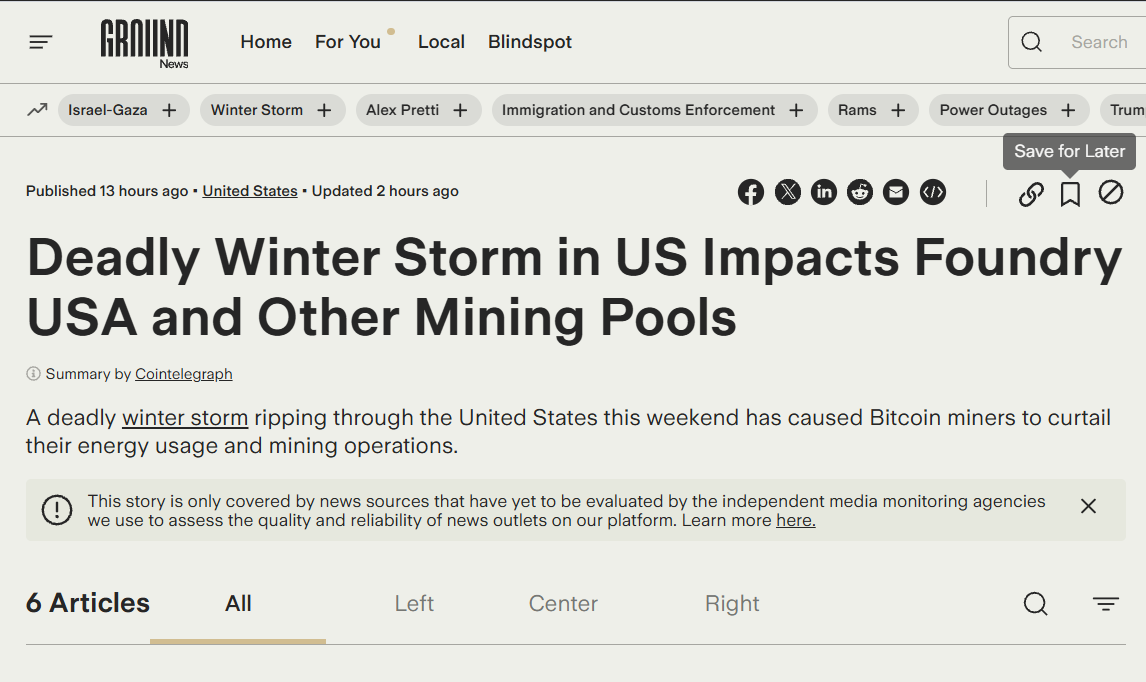
If you’re writing for clients or your own brand, trust is the asset. Ground News lets you save stories so you can return later, keep your links organized, and build a cleaner citation trail as your post evolves, creating an unbiased estimator of the facts.
When you summarize a number, aim for a fair, tight format:
- State what the number measures (not what you wish it measured).
- Add the timeframe and the baseline.
- Include at least one limitation, like sample size, definitions, or what’s not counted.
That last line is the difference between “sharing a hot take” and publishing something readers can rely on.
A quick pre-publish checklist to avoid spreading bad stats
When you’re moving fast, you need a repeatable habit, not a long research ritual. Think of this as your final scan before scheduling the post, sending the email, or uploading the carousel; it’s essential for sound decision-making.
Run the checklist to guard against statistical bias, then do one last look in Ground News to confirm you’re not repeating a narrow frame as if it’s the whole story. Over time, this gets quicker, and your drafts get cleaner on the first pass.
The 7 questions to ask before you share a number
- What’s the source? If you can’t name it and link it, don’t use it.
- What’s being measured? Define the metric in plain words.
- What’s the timeframe? A one-week spike isn’t a long-term trend; test against the null hypothesis that it’s random noise.
- What’s the baseline? “Up 40 percent” compared to what?
- Is it per-person or total? Totals can hide real-world impact.
- How big is the sample? Small samples can swing hard due to a flawed sampling process, leading to Type I errors in which you detect patterns that aren’t actually there.
- What’s left out? Check for exclusions, narrow definitions, or missing regions.
When to pause and rewrite your headline or caption
Pause if the stat appears in only one outlet, the chart has no source, the number changes meaning across articles, or your claim depends on a loaded word like “collapse” or “explosion.”
Rewrite toward calm and specific. Swap “soaring” for “rose 6 percent year-over-year,” then add one line of context (how it was measured, and what might limit the result). If Ground News shows mixed coverage, reflect that honestly instead of forcing a single storyline, treating it like a statistical test with inconclusive results.
Conclusion: Bias in Numbers is Real
Statistical bias in numbers is usually about framing and selection, not broken arithmetic. Once you train your eye for timeframes, baselines, samples, and wording, you’ll spot problems faster than you think.
Using Ground News before you publish helps you compare coverage, notice what’s missing, and avoid repeating a stat that only works in one narrative. That protects your credibility, and it makes your research process less stressful.
Pick one post idea you’re working on this week, run the core claim through Ground News, then update your draft with clearer context that reveals the true value and at least one extra viewpoint your audience wouldn’t expect.
(A Pro Ground News plan starts at only .83 per month) Save 40% off the Vantage plan with my affiliate link.
Frequently Asked Questions About Bias and Statistics in Numbers: How to Spot It Fast With the Ground News App
It’s when a stat is technically true, but presented in a way that pushes you toward a conclusion. You’ll see it in cherry-picked time frames (starting the chart at the best or worst month), missing context (no baseline, no comparison group), or misleading “big” numbers (a scary total with no per-capita rate).
Watch for common patterns:
Percent without the base: “Up 50%” sounds huge, until you learn it went from 2 to 3. Totals without population: A larger state will almost always “have more,” because it has more people. Averages hiding extremes: A mean can mask a wide spread, or a few outliers. Relative risk only: “Doubles your risk” might mean 1 in 10,000 to 2 in 10,000.
Your job isn’t to distrust every number. It’s to pause and ask what’s missing before you repeat it in a post, a report, or a client pitch.
Ground News can speed up your first pass by letting you compare how different outlets cover the same story. When a claim relies on numbers, the “tell” is often in what gets emphasized: one side highlights a percent change, another shows the raw count, and another adds historical context.
Use it to sanity-check the frame:
Compare headlines and summaries: Are they using different units (percent vs dollars, totals vs rates)? Scan across outlets: If one cluster runs with a single stat and others don’t, that’s a cue to verify it. Look at bias distribution: If coverage is concentrated on one side, you’re more likely to see selective framing.
Ground News won’t validate a statistic for you, but it can quickly show you where the framing differs, so you know what to fact-check next.
Run a fast “numbers hygiene” check before you quote it:
What’s the source? Find the original study, dataset, poll, or report. What’s the denominator? Per person, per household, per user, per $1,000, per 100,000? What’s the time window? One week, one year, pre-event vs post-event? Is it absolute or relative? “Up 10 points” is different from “up 10%.” What’s the comparison? Compared to what baseline, location, or group? Any missing groups? Who was included or excluded (age, region, sample size)?
If you can’t answer at least three of these from the article, don’t treat the number as settled. Use Ground News to find other coverage, then trace back to the primary source.
Don’t copy the headline number and move on. Instead, restate the metric in plain terms and add the missing context that readers need to understand it.
A simple approach that keeps you honest:
Name the unit: “per month,” “per 100,000 people,” “median household.” Add the baseline: “from X to Y,” not just “up 30%.” Clarify the group: “among first-time buyers,” “in urban districts,” “for respondents who…” Link to the primary source whenever possible, and label it clearly.
If you’re writing for clients, add a one-line “how to read this” note under the stat. It reduces confusion and protects your credibility when someone later challenges the number.
Start by assuming they may not actually disagree; they may be citing different measures. One outlet might use year-over-year percent change, another month-to-month, and another uses a different dataset.
When you see conflicts:
Check whether they’re using the same unit and time frame. Find the shared primary source (or confirm they’re using different ones). Treat single-source numbers with caution, especially when they drive a strong claim. Use Ground News to quickly locate multiple write-ups, then follow the citations back.
If you can’t trace the number to a clear origin, you can still report the uncertainty. Write it as, “Reports cite X, but the underlying dataset isn’t linked,” and move on without building your whole argument around it.
(I’ve used this app for over 5 years and have been an affiliate as I love the product.)

- How To Get Facebook Reviews: 10 Strategies For Your Page - March 26, 2026
- Top Blogging Categories To Have On Your Blog For Better SEO - March 24, 2026
- Writing Guest Posts for Blogging That Actually Grow Your Reach - March 24, 2026