
“Everything is online now.” You hear it all the time, and it’s not wrong. Your customers immerse themselves in digital marketing as they scroll, search, compare, and buy from their phones. But here’s the part people miss: offline marketing strategies still work because people still live offline.
You still meet neighbors at the school pickup line, notice a sign on the way to the grocery store, and remember the business that sponsored the local 5K.
Those real-world touchpoints can build trust faster than another swipe-by ad, especially when you’re trying to grow locally. They excel at increasing brand awareness in your community or selling products that require confidence (such as home services, health, coaching, or higher-priced products).
Even now, many businesses keep a meaningful share of their budget offline, and channels like direct mail, events, radio, and out-of-home ads continue to perform. You’ll learn when offline makes sense, which marketing tactics are realistic for small businesses and bloggers, and how to track results so you’re not guessing.
Estimated reading time: 13 minutes
Table of Contents
Key Takeaways
- Offline marketing strategies still work as they build trust and local visibility, especially for small businesses.
- Despite the digital focus, offline marketing accounts for 40% to 50% of U.S. ad budgets in 2025-2026, demonstrating its ongoing viability.
- Direct mail and events deliver strong response rates and high-quality leads, making them effective channels for engagement.
- While offline marketing may have higher upfront costs and slower feedback, tracking can be established through tools like QR codes and unique offers.
- Combining offline marketing with online follow-up enhances customer loyalty and increases overall marketing effectiveness.
Is offline marketing and traditional marketing still viable today, and what the numbers say
Offline marketing is simple: it’s any marketing that reaches people away from a screen. That includes direct mail, print ads, community posters, radio, sponsorships, in-person events, and even a well-placed brochure at a partner location.
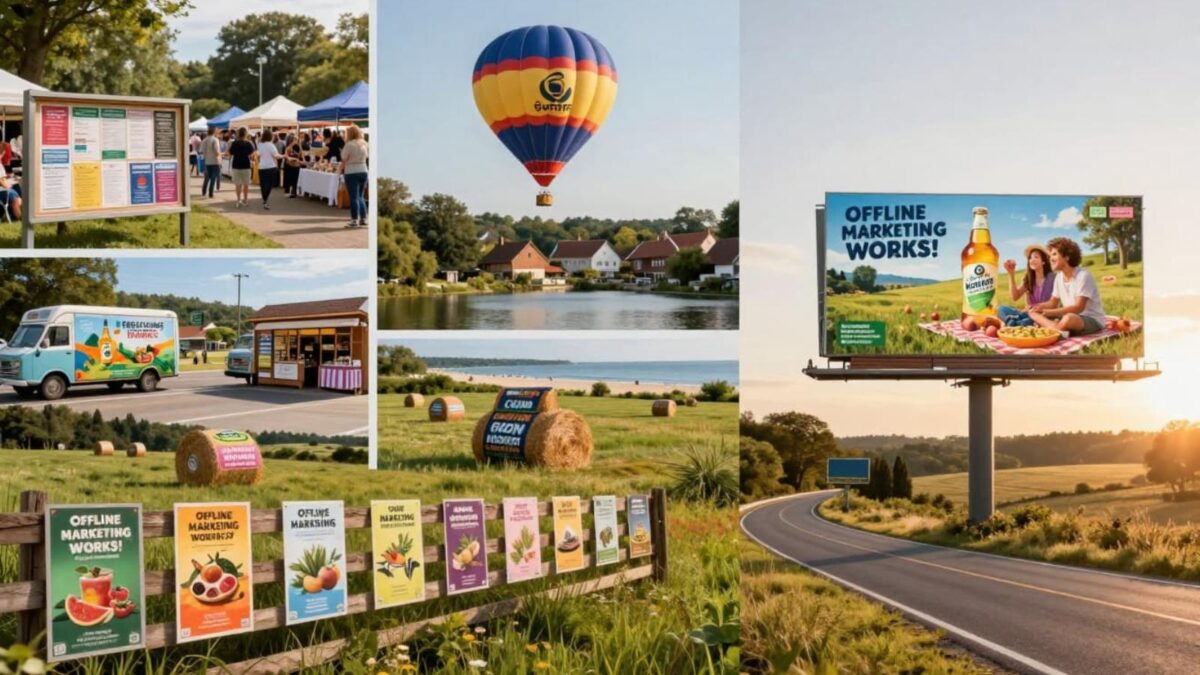
So, is it still viable in 2026? Yes, if you use it for what it does best: attention, trust, and local visibility.
Recent industry summaries put offline at roughly 40% to 50% of total U.S. ad budgets in 2025 and 2026, depending on category and company mix (offline-heavy local service brands skew higher). That’s not a niche experiment.
That’s a lot of money continuing to flow into real-world channels because they still drive sales and store visits.
A few proof points stand out:
- Out-of-home (OOH) (billboard ads, posters, transit, digital screens in public places) has shown steady growth, with estimates in the 8% to 10% per year range through 2026 in many markets.
- Direct mail continues to post real response rates. Recent roundups commonly cite average response rates of 2.96% to 3.5%, with postcards often outpacing letters for local promos. A large compilation of direct mail statistics for 2026.
- Events produce high-quality leads because you’re meeting people face-to-face. Industry comparisons often report higher close rates (roughly 20% to 50%) for event-sourced leads than for purely digital volume leads, because trust is built earlier in the process.
The reality check: offline isn’t “better” than online. It’s different. It works best when it supports a clear goal (get calls, drive foot traffic, grow your email list, book consults) and when you connect it to an online follow-up path.
Why offline marketing can beat digital in terms of trust and memory
Think about the last flyer you held, the last booth you walked past at a local fair, or the sign you keep seeing near the highway exit. Physical marketing sticks because it’s tied to a place and a moment.
Offline touchpoints can also feel more credible and improve your brand image. A postcard in your mailbox suggests the business is established enough to invest locally. A vendor table suggests the owner showed up. A sponsorship banner suggests the company is part of the community, not just chasing clicks.
Out-of-home is especially strong for memory because it wins on repetition, much like television ads and radio ads. You don’t need someone to click today.
You need them to remember you later when the problem shows up (their heater breaks, they need a haircut before a wedding, they finally decide to hire a bookkeeper).
If you’re a small business owner, this matters because repeat customers and word of mouth often come from trust and brand loyalty, not targeting tricks. If you’re a blogger or creator, it matters because offline exposure can turn you into “the local expert” faster than another social post.
Where offline struggles, cost, targeting, and tracking
Offline marketing has downsides, and you should be honest about them upfront:
- Higher upfront costs: printing, postage, booth fees, and sponsorships.
- Less precise targeting: you can target neighborhoods and audiences, but not at the pixel level.
- Slower feedback: you might wait days or weeks to see results.
- Tracking takes effort: you don’t get click-through rates handed to you.
Still, measurement isn’t impossible. You just need simple tools: QR codes, unique short URLs, coupon codes, call-tracking numbers, and one basic habit that works in any store- or service-based business: asking “How did you hear about us?”
If you build tracking in from day one, offline becomes a testable channel rather than a gamble.
Offline marketing tactics that still pay off for small businesses and bloggers
You don’t need a giant budget or a national brand to make offline work. You need the right match between channel and goal, plus one clear offer. These tactics are especially effective for businesses offering professional services.
A good way to think about it: offline gets you noticed, online helps you close. Offline starts the relationship, online keeps it moving with reviews, photos, and follow-up emails.
Here are the offline plays that tend to be realistic for small businesses and bloggers, and easy to test without turning your month into a logistics project.
Direct mail that people actually read (postcards, letters, flyers, and pamphlets)
Direct mail works when you stop treating it like “mass mail” and start treating it like a helpful local nudge. The best campaigns feel like a neighbor talking to a neighbor.
Recent direct mail roundups often cite open rates in the 30% range and response rates around 3% for local categories, which is strong when your average customer value is high. For more context on why mail response still holds up, see why direct mail ROI keeps rising.
A quick snapshot of commonly cited benchmarks:
| Category | Typical Open Rate | Response Rate |
| Local Small Businesses | -35% | -3% |
| Retail | -37% | -3% |
| Service Providers | -38% | -3% |
What to do this week:
- Pick one tight area (a ZIP code or 2 to 3 neighborhoods).
- Choose one offer (no menu of options).
- Add a deadline (10 days is enough).
- Use one call to action (call, book, or claim).
Blogger angle: send a postcard promoting a free local guide or mini-workshop, then drive people to sign up for your email list. A “Top 25 weekend spots” guide can outperform a generic “subscribe” message because it gives people a reason to keep you.
Local events and partnerships that create higher-quality leads
If you’ve ever met someone in person and thought, “This is a real relationship now,” you already understand why events convert. These create stronger community engagement and brand exposure through networking activities like trade shows and speaking opportunities that build authority.
Great options include pop-ups, vendor tables, workshops, Chamber of Commerce meetups, school fundraisers, and strategic partnerships with nearby businesses (a gym and a smoothie shop, a florist and a wedding photographer, a realtor and a home stager).
Strategic partnerships help share costs and reach new customers.
You don’t need a huge crowd. You need the right crowd.
A simple event checklist:
- One sign-up path: QR code to a form, or a clipboard sign-up sheet.
- One small giveaway: a $25 gift card, a free audit, or a mini product bundle.
- Promotional materials ready for hand-offs: business cards or flyers.
- One clear pitch: what you do, who it’s for, what happens next.
- Follow-up within 48 hours: text or email while they still remember you.
Out-of-home and print placements that make sense on a small budget
Out-of-home isn’t only giant billboards.
If you’re local, smaller placements can be smarter:
- Community boards (libraries, coffee shops, gyms)
- Posters in partner businesses
- Print ads in local magazines and neighborhood newsletters
- Digital screens inside stores or fitness centers
Out-of-home works best when people see it repeatedly near where they buy or commute. It’s a reminder, not a one-time pitch. It’s also great for categories where “top of mind” matters (restaurants, salons, pet services, cleaning, fitness, seasonal services).
When to skip it: if you can’t run it long enough to get repetition, or if your offer requires a lot of explanation. In those cases, spend your money on an event, a direct mail test, or a partnership where you can actually talk to people.
If you want a practical take on local placements and event tie-ins, VistaPrint’s local marketing guide can help you think through formats without overcomplicating it.
Radio and local audio, a shortcut to awareness in your area
Radio still reaches commuters, older demographics, and local audiences who don’t live on social media apps, unlike social media, which skews younger.
In many markets, weekly listenership is still very high. Some industry summaries estimate radio can return multiple dollars per $1 spent when your offer is simple, your tracking is clean, and you measure return on investment carefully.
Radio works best when:
- You serve a defined area
- You can answer the phone or book fast
- You’re offering something easy to act on (a seasonal special, a new opening, a free estimate)
A low-risk test: run a short campaign with one offer and one tracking method, like a memorable URL or a “say this code” discount.
Make offline marketing measurable, so you know what is working
Offline gets dismissed because it’s “hard to track.” In reality, it’s hard to track only when you try to track everything.
You’ll get better results by running offline marketing campaigns like simple experiments. One goal, one offer, one tracking path, one decision at the end: scale, tweak, or stop.
Here’s a measurement system you can run without fancy software:
- Pick one goal: calls, bookings, store visits, email sign-ups, or sales of one product.
- Choose one offer: a first-time discount, a bundle, a free consult, or a limited-time bonus.
- Set a time window: 2 weeks for direct mail, 30 days for OOH, one weekend for an event.
- Track the leading indicator: form fills, calls, and coupon redemptions.
- Track the outcome: revenue, booked jobs, new subscribers, repeat visits.
- Decide your next move: keep it, kill it, or adjust one variable.
If you want to compare online and offline benchmarks at a high level, online vs offline marketing statistics for 2026 can help you set realistic expectations.
Use simple tracking tools, QR codes, short links, and unique offers for offline marketing strategies
The rule is: one offline campaign equals one unique pathway. Don’t mix three tactics and then wonder what worked.
A few clean options:
- QR code to a dedicated landing page (best for posters, flyers, event signs)
- Short URL printed in large type (best for radio, community boards)
- Press releases with unique short URLs or dedicated landing pages (best for media outreach)
- Unique coupon code (best for retail and services with point-of-sale)
- Call tracking number (best for service businesses that close on calls)
Keep it consistent. If you’re mailing postcards to a single neighborhood, use a single landing page and a single code for that drop. If you sponsor a local event, use a different code for that event. Your goal is clarity, not perfect attribution.
Connect offline marketing touchpoints to your online assets (your “phygital” setup)
Offline attention fades fast if you don’t give people a next step. Your job is to turn “I saw you” into owned traffic you can reach again, all while connecting your real-world presence to your online brand.
A basic phygital setup looks like this:
- Your printed item points to one landing page.
- That landing page points to one action (book, call, join).
- Your follow-up points to proof (reviews, before-and-after photos, testimonials, FAQs).
Put these on the landing page:
- A headline that matches the offline offer
- 3 to 5 bullet benefits
- Social proof (one short testimonial is enough, and these assets can also be shared on social media to close the loop)
- A clear button (Book, Get Quote, Download Guide)
Avoid these:
- Your full homepage menu
- Three competing offers
- Long paragraphs that sound like a brochure
Also, remember the real-world behavior loop: many people notice you offline, then look you up later on their phone. That’s why your Google Business Profile, reviews, and site basics still matter, effectively bridging offline and digital marketing.
Conclusion: Offline Marketing Strategies Still Matter
Traditional marketing is still viable because it does what online often struggles with: it builds trust quickly, creates local visibility, and starts real relationships. Direct mail can pull strong response rates, events can produce higher-quality leads, and OOH and radio can keep you top of mind in your community.
The best results usually come from a well-executed marketing strategy that pairs offline reach with online follow-up; this synergy builds customer loyalty and long-term brand awareness so people can check reviews, book fast, or join your email list after they’ve seen you in the real world.
If you serve a local area, sell higher-trust services, or want deeper community ties, run a 30-day test. Pick one tactic, create one offer, add one tracking method, and review the results at the end.
Offline marketing and digital marketing together provide real value in reaching your target audience within the local community. Your next customer might not come from an algorithm; they might come from the corner of your town.
Frequently Asked Questions About Offline Marketing
Offline marketing is any promotion that happens outside the internet. That includes printed items (flyers, brochures, business cards, direct mail), in-person efforts (networking, events, trade shows), local media (radio, newspapers, magazines), and visibility tactics (signage, billboards, sponsorships).
You don’t need a huge budget to get results offline; you need clear targeting and a simple offer. Start with tactics that let you control costs and reach people close to buying.
You can track offline marketing without fancy tools, but you do need a plan before you print anything. The goal is to connect each offline piece to one measurable action.
You’ll get better results when offline points to online, and online supports offline. Think of it as one customer path, not two separate plans.

- Porn on X (Twitter): What’s Allowed and How to Block It - September 29, 2026
- Dolphin Radar Review 2026: Instagram Follower Tracker (What I Saw After 2 Weeks) - September 29, 2026
- 5 Reasons to Review Your Deleted Tweet History Before Your Next X Cleanup - September 29, 2026
Enjoy this content? Help me show up more often in Google by adding Inspire To Thrive as a Preferred Source:


Hi Lisa,
I think that in the modern world, many people have actually started to move away from the “brick and mortar” type of marketing. These are some valuable points. I think there is still quite a bit of value that can be added by going back to the more physical offline marketing techniques out there as you’ve mentioned above.
What has worked particularly well for our company is posters and flyers. Now, I’m sure many of them go straight into the trash, but we still get some valuable leads!
Hi Jonathan, welcome to Inspire To Thrive. That’s good to know Jonathan. What type of business are you in? Posters and flyers can direct people to a physical location or a website. You have me curious about the business. Thanks for coming by and make it a great day!
All are creative ways to get around the virus and its various closings, etc. Smart tips here Lisa. I do little offline marketing but the idea of radio broadcasts seems appealing. Sweet way to advertise your business offline. I did an interview years ago for a radio show with 60 plus US affiliates. Running ad spots for stations makes sense to gain massive exposure.
Ryan
Thank you Ryan. I think podcasting on the radio may make a comeback for radio though more fragmented like TV and now like social media. Having affiliates like that helps a lot I’m sure! Thanks for your input on this Ryan and make it a great day.