
If Facebook marketing feels harder in 2026, you’re not imagining it. It’s easier than ever to make Facebook marketing mistakes than ever before.
There’s more competition in the feed, especially with the rise of social commerce, more video-first experiences (especially Reels) focused on brand awareness, and more automation inside Ads Manager.
At the same time, tracking isn’t as clean as it used to be, so “easy” wins like boosting a post and watching sales roll in don’t happen often.
The good news is you don’t need a complicated system to improve results. You need to stop repeating the same Facebook marketing mistakes to avoid quietly draining time, budget, and trust.
Below is a practical list of quick fixes you can apply, whether you’re a small business, a creator, or a blogger trying to grow an email list. Content strategy mistakes that waste time and make your content easy to ignore.
Estimated reading time: 9 minutes
Table of Contents
Key Takeaways
- In 2026, Facebook marketing is tougher due to increased competition and tracking challenges, making it crucial to avoid common Facebook marketing mistakes.
- Clarify your content funnel with attention, value, proof, and offer posts to guide your audience effectively.
- Use creative formats, such as short videos and carousels, instead of static images to capture user interest.
- Simplify your ad setup with fewer, more focused ad sets so Meta’s AI can learn effectively from meaningful data.
- Build trust by avoiding clickbait, maintaining privacy, and focusing on first-party data to improve your Facebook marketing results.
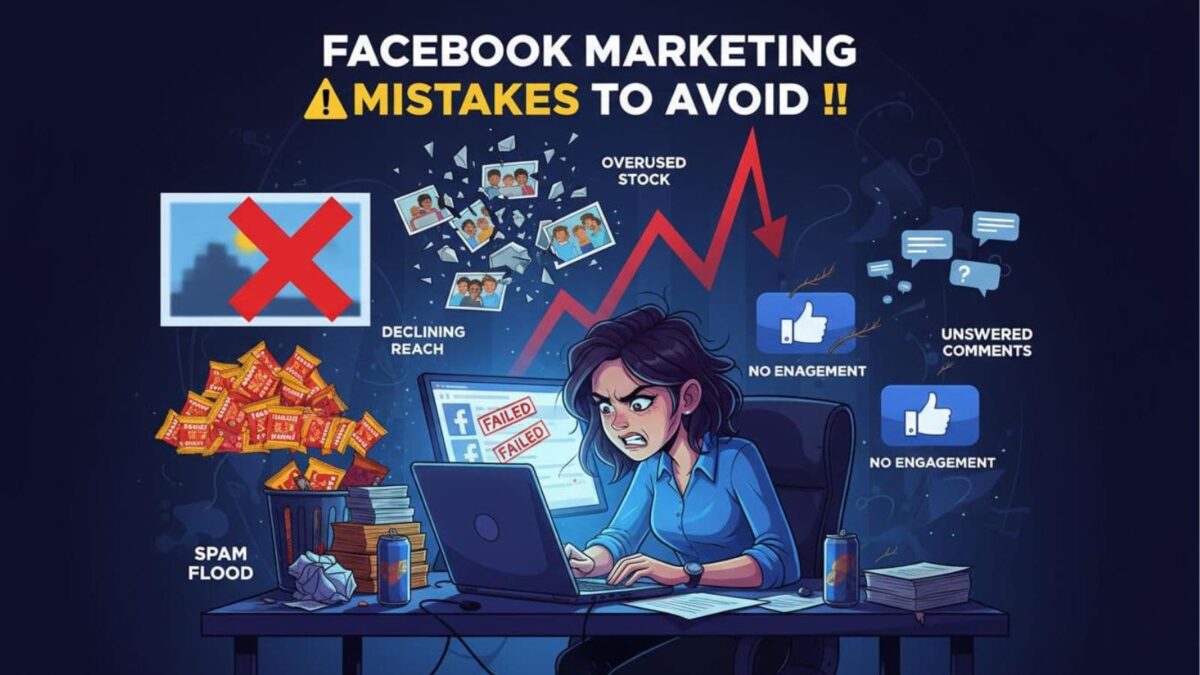
What Are Facebook Marketing Mistakes?
Facebook marketing mistakes are the missteps that waste your budget, hurt reach, or turn off the right people. You make them when you post without a clear goal, target too broadly, ignore your data, or run ads with weak creative and no strong call to action.
They also show up when you chase vanity metrics, reply late to comments, or send clicks to a slow, mismatched landing page. Fixing them starts with tighter targeting, better offers, and consistent testing to see what’s working.
Posting without a clear funnel, so people never know what to do next
A common 2026 pattern looks like this: you post a tip, then a random promo, then a link to your latest blog post, then a quote graphic. Nothing is “wrong” with any single post, but together they don’t guide your target audience anywhere. The result is lots of activity, little momentum.
Instead, use a simple funnel you can repeat to avoid Facebook marketing mistakes:
- Attention post: a short Reel or punchy text post that calls out a problem.
- Value post: a quick how-to, mini tutorial, or carousel.
- Proof post: social proof like a testimonial, result, screenshot, or story.
- Offer post: one clear next step.
- Retargeting: show a follow-up ad to people who watched, clicked, or engaged.
Example for a blogger: your “offer” is a lead magnet. Your attention post is “Stop losing readers after one post”; your value post is a carousel about internal links; your proof post shows a subscriber growth snapshot; then you send people to the opt-in page.
Example for a service business: your “offer” is a consult call. Your attention post highlights a pain point (“Your ads get clicks but no leads”), your value post explains one fix, your proof post shows a client win, then your offer post points to your booking page.
Relying on old formats (or constant boosting) instead of creative people actually stop for
In 2026, plain image posts and constant boosted posts often stall because they don’t earn attention. Facebook’s feed is crowded, and many users spend time on short-form video. That doesn’t mean you must dance on camera. It means your content needs a fast hook and a clear point.
Short-form video ads (15 to 60 seconds), carousels, and simple UGC-style clips usually outperform “perfect” graphics because they feel more human, drive engagement, and are easier to consume.
Use this quick creative checklist:
- Strong first line: Say the outcome or problem in the first sentence.
- Clear promise: tell people what they’ll get by watching or reading.
- One idea per post: don’t cram three topics into one\
- Easy call to action: “Comment ‘guide’,” “Save this,” “Get the checklist,” “Book a call.”
Also, refresh creatives monthly (or sooner if you run steady ads) to manage ad frequency. If your ads look too similar for too long, performance can fade, and delivery can tighten.
If you’re running paid traffic, particularly Facebook ads, this overview of Meta ads best practices to follow in 2026 can help you sanity-check your creative and setup.
Ad setup mistakes that burn budget and confuse Meta’s AI
Meta’s algorithm for Facebook ads in 2026 is heavily AI-driven. It learns from the signals you send (who converts, what they do next, which creative gets real engagement, relevance score). When your campaign is messy, the system “learns” the wrong lessons, and you pay for it. Clean conversion tracking is key here.
You don’t need a complex ad account to win. You need clean signals and a simple structure, then you watch what happens and make small moves.
Inside Ads Manager, use a custom dashboard to keep an eye on basics that tell you if the system is getting traction: cost per result, ROAS, CPM, frequency, click-through rate, landing page views (not just clicks), and whether your leads or sales are actually qualified.
Targeting everyone with one message, then wondering why the results are weak
One-size-fits-all ads feel like wallpaper. People scroll right past them because they’re written for “everyone,” which means no one feels seen.
Segment in a simple way:
- Cold audience: people who don’t know you. Lead with the problem and a low-friction next step (a free guide, a quiz, or a short video).
- Warm audience: video viewers, page engagers, site visitors. Lead with proof and specifics (what changes, how fast, for whom).
- Customers or leads: people already on your list. Lead with upgrades, add-ons, and retention (a next product, a refresh, a check-in).
Once your core message and creative are solid, you can build custom audiences and let audience expansion or lookalike audiences help find similar people. But expansion can’t rescue a vague offer or a generic ad.
Tracking the wrong things (or running with a messy pixel), so optimization goes in the wrong direction
If you optimize for clicks, you’ll often get clicky people, not buyers or subscribers. In 2026, with tracking less perfect, optimizing for the wrong event makes things worse fast.
A “dirty” Facebook pixel usually looks like this: duplicate events firing, wrong events mapped (purchase firing on a thank-you page for a freebie), or old campaigns that trained the account on low-quality traffic.
Do a simple monthly cleanup:
- Confirm your key events are correct (lead, complete registration, purchase).
- Remove or pause campaigns that drive junk traffic.
- Building too many ad sets and starving them of data
Blogger tip: track email signups or key page views, not just link clicks. If you want more structured guidance on campaign signals and what Meta’s system prefers now, skim this Meta Ads in 2026 playbook.
It’s tempting to split everything: five audiences, five placements, five demographics, and a “just in case” ad set. Then each ad set gets tiny spend, and Meta can’t learn.
Start with a manageable structure for your Facebook ads:
- 1 to 3 ad sets for cold traffic (broad or lightly guided, exclude past converters).
- 1 ad set for warm retargeting (engagers, video viewers, site visitors).
- 3 to 6 creatives per ad set for A/B testing angles.
Example budget split at $30/day using campaign-level budgeting: $20/day to cold, $10/day to warm. Let it run long enough to collect data, then shift spend to what’s getting real results.
A simple rule: if an ad gets no meaningful signs (no saves, no link clicks, no leads) after a reasonable test window for your budget, cut it and replace the creative. Don’t keep “fixing” targeting when the message is the real issue.
Trust and compliance mistakes that can quietly kill performance (or get you restricted)
In 2026, performance and trust are tied together. People are quicker to hide ads, report sketchy claims, and ignore brands that feel slippery.
Privacy expectations are also higher, so you can’t act like platform data is guaranteed forever.
Using clickbait, vague promises, or hype that brings the wrong people
Clickbait gets attention, but it often attracts the wrong target audience. They click, bounce, and train your ads toward low-quality engagement. Over time, your results get worse, not better.
Use a simple rewrite formula for your ad copy: specific outcome (your value proposition) + who it’s for + proof point + honest CTA.
Two quick hook rewrites:
- Before: “This ONE trick will explode your sales!” After: “If you sell a service, try this 10-minute follow-up message. It helped me book 3 calls last month. Want the template?”
- Before: “You’re doing Facebook all wrong!” After: “If your boosted posts get likes but no leads, this is the fix I’d start with today. Save this and test it this week.”
Ignoring the privacy-first reality and relying only on platform data you do not control
Tracking is less reliable, so your safest move is to build first-party signals you own: email subscribers, lead forms with clear consent, and offer pages that convert even when attribution is fuzzy. These deliver key audience insights you control.
A practical checklist:
- Verify your domain and mobile optimization to keep your setup cleaner across your web properties.
- Use tracked landing pages (consistent URLs and UTMs).
- Keep forms simple (name and email are often enough).
- Store leads in your CRM or email tool, not only inside Meta. This data lets you target niche audiences directly.
Conclusion: Facebook Marketing Mistakes To Avoid
You don’t need more hacks, you need fewer leaks. The biggest Facebook marketing mistakes to avoid in 2026 are unclear funnels, stale creatives, messy campaigns, and weak trust signals.
Your simple action plan is: (1) pick one funnel goal, (2) refresh formats and hooks, (3) simplify campaigns, (4) clean up tracking, (5) tighten claims and build first-party data.
Audit your posts and Facebook ads from the last 30 days, then fix just one thing first. Once momentum returns, the rest gets easier.

- Instagram Reel Length 2026: Is 90 Seconds Too Long? Best Lengths, Limits & Testing Tips - October 2, 2026
- How to Build a Traffic Pipeline from Instagram to Your Blog or Store - October 1, 2026
- Instagram Tools Aren’t One-Size-Fits-All: Match the Tool to the Job - September 30, 2026
Enjoy this content? Help me show up more often in Google by adding Inspire To Thrive as a Preferred Source:
Hi Monica,
Good article. This should be like a checklist for Facebook marketing mistakes. I will definitely take these points into consideration for my ads on Facebook from now. Thanks for this awesome article
Thanks for dropping y, Elphin. Do let us know if you catch some which are not here.
Hey Monica,
Today’s world everybody’s using Facebook to promote brands and promote their businesses but not everyone knows the correct Facebook marketing strategies and because of that they didn’y get good result. This post is really very useful to everyone and to me as well. It helps to know more trends. Thanks for sharing.
Hazel.
Hi Monica,
I am very new to Facebook Marketing.
I was in much need of these tips. Thanks for these and I will make sure that I don’t commit these mistakes.
Thank You!
Thnx for share this article Really good work and idea !
Those are some awesome tips. Also if you are looking to build brand, frequent engagement with followers & also giveaway is also good way to give an initial boost.
Thanks for your insights
Hey Monica,
Every point you shared with us is really awesome and these are the true fact indeed. I usually use Grammarly plugin to my browser and it corrects the typos and some grammatical mistakes. I also avoid live video and don’t care about the competitor. I will definitely do these things from now. Thanks a lot for this great post.
Hi Monica,
Fascinating post you have here. Facebook is certainly a powerful social media marketing tool that if used correctly, one will skyrocket his/her business in no time.
The tips you presented are really great. However, I found these to be a major mistake among marketers. “IGNORING COMMENTS”
Facebook fans are people who find your article interesting, as a result, they made comments. If they make the effort to leave a comment or reply within a thread on your Facebook Page, they want to know that you’re listening.
If you consistently ignore posts or comments by fans , you won’t be as successful as you want to.
The other reason why you want to reply to posts from fans is that Facebook sends that fan a notification, bringing him back to your Page.
Another Facebook marketing mistake is the idea of using ones profile to market his products and services. Facebook terms of use does not support that which is why you need to create a Facebook page.
Not paying attention to this made get your account suspended.
Thanks so much for sharing this great article.
Hey Monica,
Facebook Marketing is confusing for many and the mistakes you have mentioned are common.
Not everyone is expert in knowing the current trends or what you have called the competition.
Post frequency is very important. I do that once in every 2 hours.
Thanks for sharing with us.
~Ravi
Thanks for stopping by and sharing your thoughts, Ravi.
Hi Monica,
Great tips on how to use Facebook. I tried it when I first got started.
I was so overwhelmed after reading so many tutorials and posts online.
I wish I would’ve found something like then when I got started.
I’ve since put my efforts on Facebook on the back burner.
I know, I know, I am probably missing a lot of traffic.
However, I’ve decided to focus on Pinterest. I’m not as savvy as many marketers.
I have to put all my focus on one platform to really learn it.
However, when I do start focusing on Facebook, you can bet that I’ll be checking out this post again.
Thanks for taking the time to share these tips.
Have a great day
Susan
I’ll look forward to seeing you use Facebook for marketing again. Meanwhile, good luck with Pinterest marketing, Susan.
Hi Monica,
Great tips here.
I am in love with Facebook Live videos. I see how these gain priority over other videos and heck, even other updates. Folks join my videos after getting notifications but more than that, new people are finding my videos every day. No doubt these folks see me in their feeds, even if they are not followers of mine, because Facebook gives priority to folks who use this tool to connect with their audiences.
I get how scary it feels to go live, but broadcast your first video. It gets easier and easier as you dive into the fear for the first time, as each time you face a fear, it dies a little bit more.
Thanks for sharing Monica.
Ryan
Yes, you are right. It is doing so in order to compete with the likes of YouTube. And it is true what you say, Ryan – once your first live video is out the next one is pretty easy.
Hi Monica,
It’s great to e-meet you!
Thank you for putting this post together. The one thing that hangs in the back of my mind is whether I’m following their rules or not. I was looking at their jobs tab and since I’m an affiliate for work-from-home jobs I wasn’t sure if I could post them there or not. Since I’m not sure of their rules – and I can’t find anything that addresses this in their support docs, I decided to hold off until I find out.
I’m going to check out the social media scheduling tool you suggested. I’ve using Hootsuite but lately I’ve had problems connecting other accounts – so now I need another tool just for one profile – makes no sense so I need to look for an alternative. I’m using Buffer right now but not happy with it.
I haven’t jumped on Facebook Live but I know I need to.
Thanks for these tips Monica! Passing this on for sure. Have a great day and rest of the week!
Cori
Hello Cori! It’s nice to e-meet you too.
I don’t see why you shouldn’t post jobs there.
And yes, please do explore Facebook live as a marketing option if you want your post to be shown at the top of your followers’ news feeds.
Here’s a link that will give you a comparison of Hootsuite and SMhack. https://smhack.io/hootsuite-alternative
Happy weekend!
Hi Monica,
I love using Facebook for my business! I have done over 50 live streams already and it sure does pay off. That 95% good content and 5% sales have done well so far. Each time I give a CTA things start popping. Even when I’m giving content only I give the CTA to visit me on my blog. That caused a huge increase in readership.
Of course, following FB rules is a must! Because they do change a lot, it is my go-to reference. Whenever I place an ad, the ROI is amazing. I even like to boost a post for only five bucks or a Live Stream.
The insights are so user friendly, I look at them once a day. From there I can gauge what to do more or less of. All and all, it is a great place to market.
-Donna
That’s a great way to drive traffic to blog posts, Donna. It works out pretty cheap as well.
Facebook Insights – well, it’s so easy to understand that I don’t have to struggle with all those numbers and graphs.
Hello Monica,
Nice to see you here on Lisa’s space.
That is some good sound, people do not talk much about Facebook but its too should be given the attention as there are many
things which we need to keep in mind while working along with this social media platform.
I have always this in mind, apart from posting on weekends two many post daily I can put up on Facebook. I comment on blogs
daily around 10 to 15 blogs and I share them on social media platforms like Twitter and Facebook. So am I posting too enough
of this?
Getting our self grammatically correct is very important as it leaves a bad effect on our visitors. Being influent
on our English and writing skills is very important these days.
Thanks for the share.
Shantanu.
Hello, Shantanu!
Well, the frequency of publishing content differs from one channel to another. While it’s good to publish not more than 10 tweets on Twitter, it is better to share up to 3 posts on Facebook. It’s all about the dynamics and user behavior that drive the frequency.
Hello Monic,
Awesome Post. Facebook is one of the Widely used social networks and it has tremendous marketing opportunities. Ignoring these above mentioned things can ruin your Facebook marketing campaigns. Facebook page insights gives us detailed report on how our page works and the engagement with the users. Thanks for bringing up these helpful insights.
Have a Great Day.
Vishwajeet
Thanks, Vishwajeet. I’m glad you agree that insights are a key part of Facebook marketing. It has become all the more important now that Facebook is leaning towards paid ads. Insights will not just help you target the right audience and achieve your marketing goals but also tell you how you are spending your marketing budget.