
Note: Before proceeding to read the first word of the introduction properly, do know that I like my SEO to be simple and effective. That is why I developed a system, a pattern of actions I follow before hitting the publish button (I call it my simple SEO checklist).
I’m saying that, if you came here hoping to find some:
- over-the-top,
- overarching,
- earth-shaking,
- all-encompassing SEO strategy
move on. You won’t find it here. I’m more interested in getting real results than in high-level fluff called “too much planning; too little doing”.
You either rank or you don’t.
If you want the former and hate the latter… continue reading the article,
it begins below…
Table of Contents
Your Path To Higher Google Rankings
Whenever you publish a new article, you have two courses of action before you:
You can sit back, relax, pour some coffee; or whiskey; or whiskey in coffee (you don’t have to be Irish to enjoy their beverages), and wait for Google to recognize your awesome work and give you the rankings you truly deserve.
Or you can get busy, bustle about, and make Google give you the rank you deserve.
I recommend the latter and that’s why I wrote this article. In it, I give my own, simple SEO checklist that I follow to the tee before hitting that blue “publish” button.

This is mostly on-page SEO with a dash of link equity flow- it’s powerful stuff!
So powerful in fact, that if you do the 7 hacks I’m about to show you, you’ll be well on your way to dethroning the current king of the SERPs.
They’re king, but for how long, right?
Number one position- prepare to meet your new lord and master… (your name goes here) 🙂
#1- Content-Length- Go For The Average
It’s great and wonderful to have exceptional content because it helps you stand out. But most of the time- it’s not needed.
Google is telling you what they expect to see from your page.
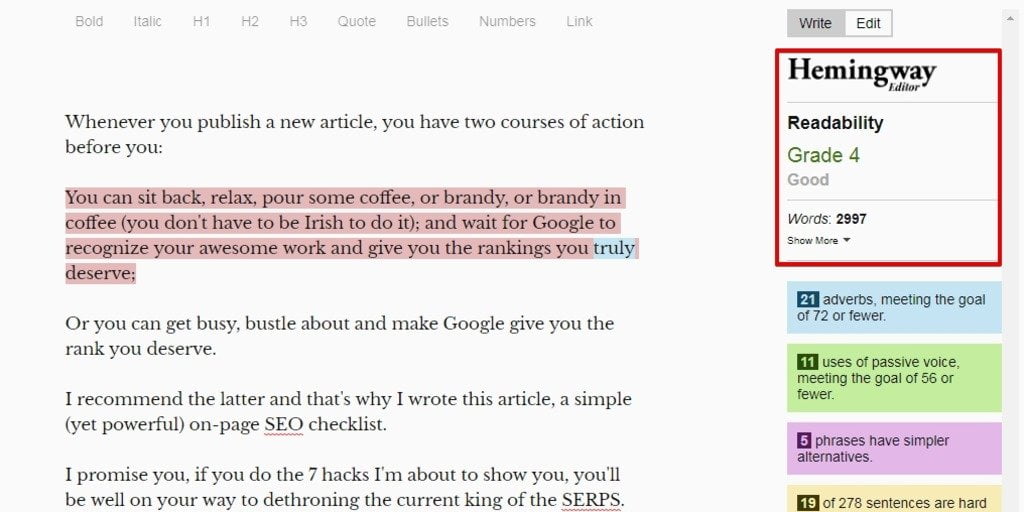
Simply type your keyword into Google, take the first 10 results, and plug them into a free tool called “Hemingway App”.
It’ll tell you the word count of every post. Then you just need to find the average by first adding up the word counts of all 10, and then dividing the number you get by 10.
And that’s the ideal word count you should shoot for.
Bonus tip
The Hemingway app will also let you calculate the average reading score.
This is something to keep in mind because posts that are written in simple English often get picked up to be featured in featured snippets and as voice search results.
Bonus tip #2
I said go for the average, and I stand behind it. If you’re chasing long-tail keywords, there’s no reason to blow up the SERPS every time you publish something new. Quality is important of course, but with long tails, you also need quantity.
However, if you’re trying to target a really popular term, a head phrase that gets a tonne of searches every day and has insane competition- then you need to outdo everyone on the first page. If they write 1000 words, you write 2000. If they write 2000 you 4000 and so on.
Content comprehensiveness is an important ranking factor and it pays to get it right when targeting competitive terms.
#2- Get Your Basic Metadata Right
Note- What? I hope you didn’t think that a simple SEO checklist can fly without some simple metadata. Simple, but powerful! Read below…
I said “basic” but I didn’t say ” weak”, or “not powerful”. Because that’d be a HUGE lie.
The right mixture of the title tag, headline, and URL, with a dash of well-crafted meta description, goes a long way in signaling Google what your page is about and what they should rank you for. (A plugin tool like RankMath can help guide you along the way.)
a) Meta Title For Your Simple SEO Checklist
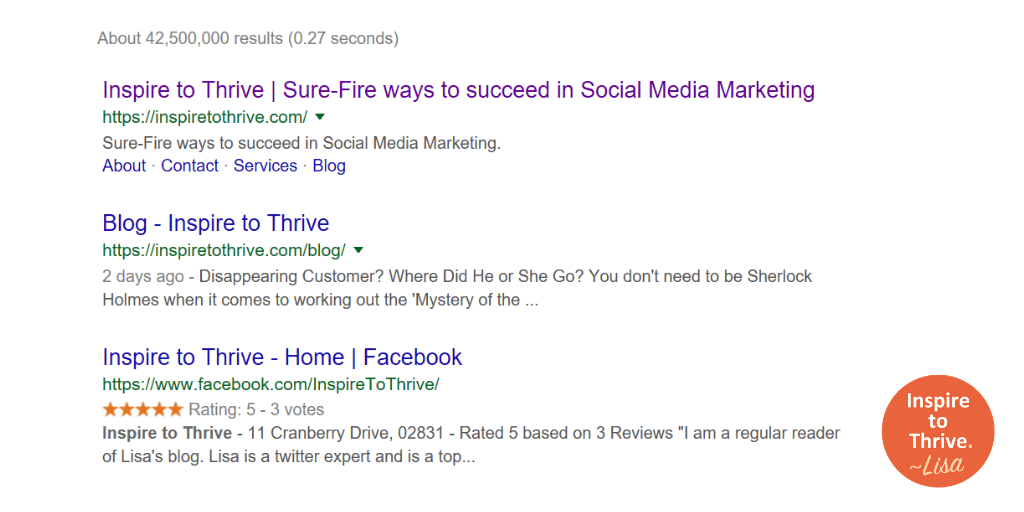
Meta title, also called SEO title, is the blue link you see in the SERPS when you perform a search.
It’s the second most important on-page SEO factor (after the content itself) and it pays handsomely to write it well.
Here’s how:
- SEO title must be short– Anything over 60 characters or 600 px will be cut off in the SERPs
- Include your target keyword, and at the beginning if possible– if not, don’t sweat it
- Write to get a click— SEO is important, but user engagement is crucial. Tell them what they’ll gain if they click.
Writing good meta titles is an art, NOT a science. Meaning, you can read and reread those tips until you’re blue in the face, but only by practicing and practicing, and then some more will you get proficient with it.
Here’s the SEO title for this post:
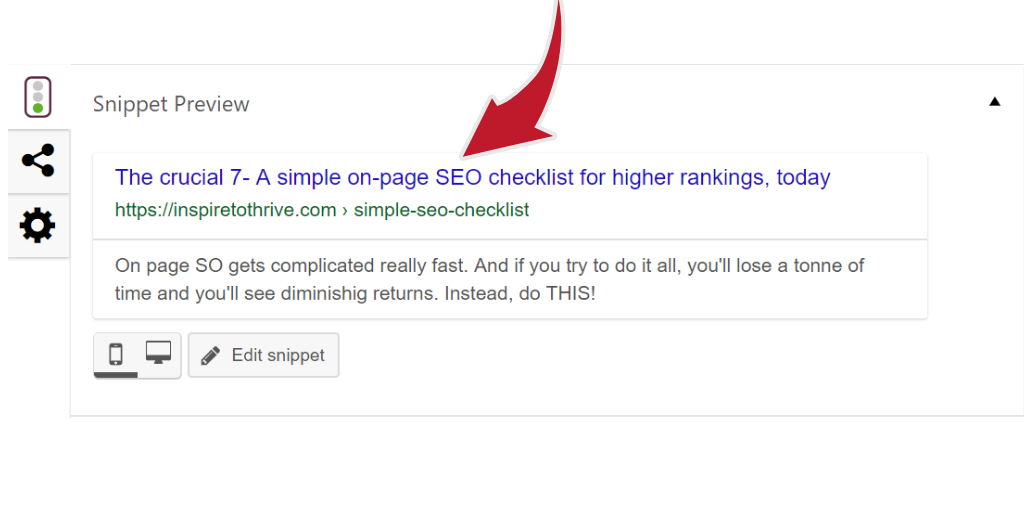
It’s short, to the point, promising, and inviting. And it took me a lot of time to learn to write like that.
Bottom line– don’t feel bad if your SEO titles suck the first few times.
Practice makes perfect.
Pro tip:
Use Portent’s tool to visualize what your meta title will look like. You can also see your URL and meta description.
b) URL for a Simple SEO Checklist
Short and sweet.
Really- that’s the advice.
- Short URLs rank better.
- Plus short URLs give a nice overview of the page.
- And short URLs are easy to read.
There is no reason not to be concise because it’s both SEO and UX-friendly.
c) Meta Description
The meta description is your ad copy, your “why” this page exists, and “why” they need to click it.
To write them well, you have 2 options:
a) Expand the SEO title’s message
You have more room here, so make good use of it by telling something more about:
- the awesome gain of clicking on your listing,
- and the huge loss of not doing it.
Also, this is an easy way to insert your keyword here, as it won’t look like keyword stuffing.
Here’s the meta description for this post:
“A simple SEO checklist- for you. Don’t get bogged down with the fluff. Do what matters the most and move on; with your business AND your rankings”
Let’s break it down real quick:
- A simple SEO checklist– my target keyword
- Don’t get bogged down with the fluff– fear of losing precious time
- Do what matters the most- what they get (most bang for their buck)
See? It works!
(But it takes practice to write like that)
b) Use ad copy- literally speaking
If your keyword is a lucrative one, you can bet there’ll be a tonne of ads above organic listings.
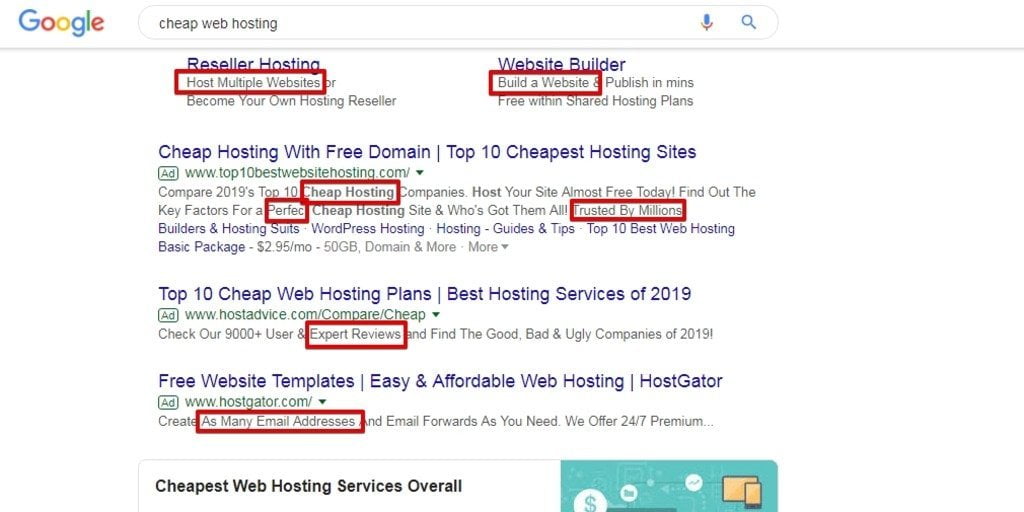
Your job is to scan and pick up pattern words; i.e., those that come over and over.
This copy is valuable because it is usually tested to death. Use the words in your meta desc. and you’ll get more clicks- guaranteed
#3 Heading Tags- Relevancy Booster and More
I’ll talk about two types of headers,
- H1
- All other types
a) H1 (the headline)
This is your post’s true headline and is not visible from the SERP itself. So, they have no impact on CTR.
Does that mean you can be careless about writing them? I mean, once they click- they’re in!
And your job is done.
Well, of course not. But you knew that already, right?
Headlines have a huge impact on bounce rate and pogo-sticking, which are crucial user experience signals. Meaning, when people land on your page, the first thing they’re going to see is your headline. And it has to be compelling enough for them to read on.
Like with SEO titles, writing headlines is an art, but here are some basic tips for you to start learning
- Try not to be clever– people hate to think online
- Be explicit and bodacious– Best headlines tell them what they’ll get if they read on; and what they’ll miss out on if they don’t
- Use a target keyword– It’s natural and people expect to see it, as it’s a clue that they’re on the right page
- Don’t use more than one keyword. You can overdo it and people are not stupid
Simple SEO Checklist Protip
Coschedule has a great tool that can help you nail some awesome headlines. Make sure you use it.
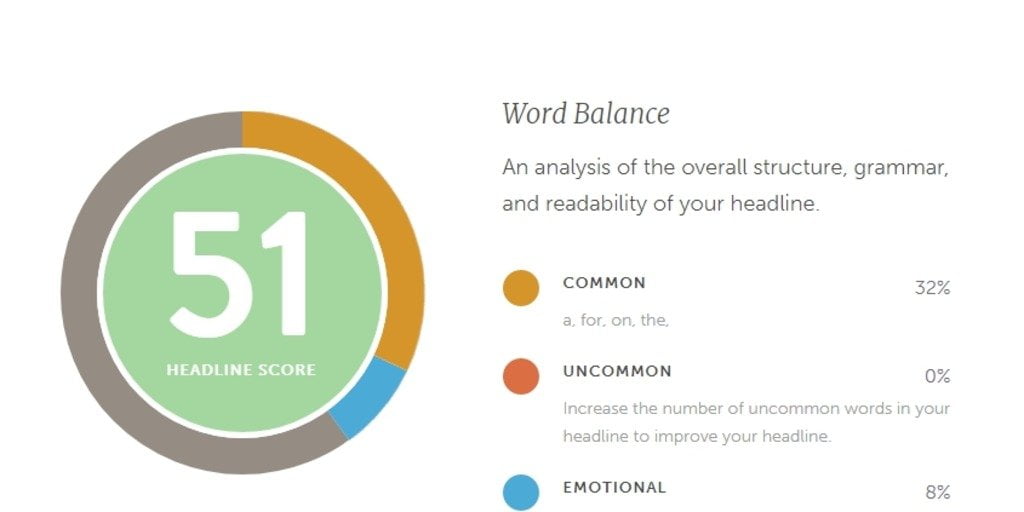
- Suggested reading: https://conversionxl.com/blog/5-characteristics-high-converting-headlines/
b) H2-H6 (the subheaders)
According to Content King, keywords in “smaller” heading tags are still a ranking factor. They help you rank better by boosting your post’s relevancy for the keyword you’re chasing.
From that advice, we gather that we should use a keyword wherever it makes sense.
I said and repeat it “Where it makes sense” Please don’t go and try to stuff keywords where they clearly don’t belong.
Header tags are a very small ranking factor and it is probable that when over-optimized, turn into spam signals for
- your page
- your site
- for your brand.
It’s scary, I know. One little element, so dangerous.
Dwell on it for a moment, then continue reading.
Pro tip- use content tables as further relevancy boosters
Tell me:
When you see a typical table of content, what does it usually consist of? Sub-headers turned into clickable anchors. And that anchor, when clicked transports you to parts of the page you want to read.
Well, isn’t it possible that keywords in subheaders, combined with the same ones in the content table (but turned into internal links); send strong relevancy signals to Google about what your page is about and what keyword cluster it should rank you for?
I think it is possible and I think that is the case with content tables. Of course, the effect is small for sure, but it is also free and completely passive, so it’s worth doing.
In other words, the page because more relevant for those keywords and ranks higher for them.
#4 Images SEO Image Hack For Relevancy Boosting
Image SEO is SEO 101- that a shameful number of people completely skip over.
Why is that?
Perhaps they think it doesn’t matter? Do or do not, the ranking s stay the same.
Or maybe their reasoning is “We don’t care about ranking in Google Images, so why should we bother?
Here’s why- well-optimized images boost your entire page’s SEO! How’s that for a reason?
Ahrefs has a great guide, but in the meantime, read these basic tips so you can start optimizing images right away
- Keyword in image filename– like this: keyword-in-image-file-name
- Keyword in alt tag– “Here are seven on-page factors that matter the most”
- No keyword stuffing– Since folks can’t see image SEO, people tend to stuff crap in there. Don’t. Algo’s are trained to spot and punish that kind of shenanigans.
- Use your main keyword once and in your first image.
For other images further down the page- use LSI’s (synonyms) - Describe the image- This is good usability for visually impaired people.
Bonus tip
Images help with your SEO a little bit, but you can boost their effect by boosting relevancy.
How?
Place images next to sub-headers, and make sure that the image alt tags contain the same keywords as the sub-headers.
That’s a double signal to Google that your page is about “your keyword”.
Note– The guide from above is not about image optimization. I already pointed you to Ahrefs guide for that. Above you will learn how to become independent of cheesy stock photos, and how to take images yourself, without expensive cameras and bullion of pricey equipment you don’t have.
Image SEO is one half of the puzzle; image quality is the other half.
Piece them together!
#5- Internal Linking For SEO
Internal links are a wonderful, underutilized part of on-page SEO. This is something I really like because internal linking is my favorite hack to get an immediate SEO boost..
Here are a few tips that will get you pretty far.
a) Link Relevantly
Links are the most important factor for Google. So saying that they pay attention to them is a huge understatement.
In fact, the Penguin algorithm is designed specifically to hunt bad links.
And link relevancy is a telltale sign of link quality. The link that is thematically relevant to your site- helps you.
The one that is off-topic- hurts you.
And get too many of those- you get a penalty.
Now you’re thinking “That’s the case with backlinks, we’re talking about internal linking here“!
The same rules apply! Relevancy must be maintained.
The only difference is that you won’t be demoted because of internal links, but they will be nullified. Meaning they’ll become sterile and won’t pass PageRank and other link goodies.
b) Use Anchor Text
This is common advice but it bears repeating as it is important.
You can use keywords with internal links, yes even exact match anchors are fine. Of course, as always in SEO, there’s a cap as to how far you can take it. You don’t want to end up like Matt Diggity and his ergonomic chair disaster.
Here’s a healthy link anchor distributor you can follow, boost your SEO, AND sleep well at night:
- Target anchor- 50%
- Url- 25%
- Generic- 25%
c) Use Internal Link Co-Occurrences
Google uses words around backlinks to determine the link’s relevancy. Because they don’t want to give weight to a non-relevant link.
Hence, the same applies to words around internal links. The difference is that you control the words you so make them count for you.
[d) Your New Post Craves Authority- Give Them What They Want
Google doesn’t assign Page Rank to new posts and pages right away. In fact, they remain sterile for the first 3 months or so. And that’s one of the reasons why posts take their sweet time to start ranking for stuff.
But the thing is- it’s not their fault!
And you should help them.
And here’s how:
Point relevant internal links to your new post right away.
This post is about “on-page SEO”, so I’ll be combing through Lisa’s site
like this: site:inspiretothirve.com on-page SEO
And voila- several dozens of posts ready to share their link equity with their new infant brother.
Now:
Since I’m a guest here (thanks Lisa, it’s an honor) it’s up to her to link to this post and boost it quite a bit.
But this is the process YOU can apply to your site, and I suggest you do because more internal links = fewer backlinks.
The only drawback of this technique is that it can only be used on the posts you care about the most. Because you also don’t want your post to be littered with links.
Ugly and ineffective.
#6- External linking for SEO simple checklist
Question: Did you know that external links are good for SEO?
a) Put Yourself In The Same Tier As The Big Guys With A Simple SEO Checklist
You want to show Google that you hang out with the squeaky-clean dudes in your niche. The ones where if you joined Panda and Penguin together; and Panda brings his telescope and Penguin brings his microscope, they’d still be able to find absolutely nothing.
And their eyes would hurt from so much white hat brightness.
You achieve this by linking out to mega-authority sites. It’s the single easiest way to hint to Google- ” yes, I belong”.
Pro tip
Linking out to influencers is the easiest way to start doing outreach. Everyone loves a pat on the back, for a job well done.
For example, when I wrote this article on infobunny.com I like a bunch of influences (including Lisa). But I didn’t do it willy-nilly. I knew I was going to contact them right after the fact.
Here’s my email to Lisa:
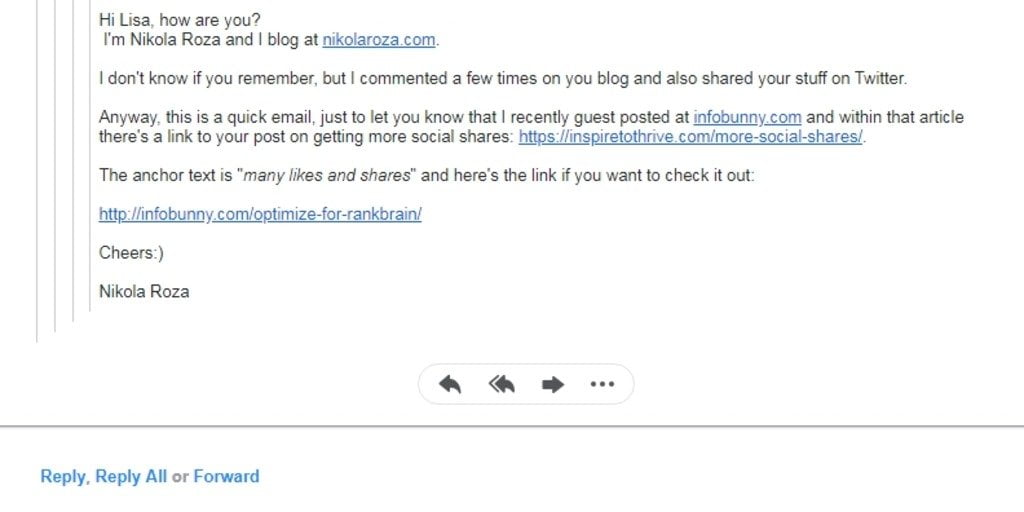
And here’s me contributing to her site.
Is it just because I linked to her once?
No
As per her words, I also
- shared her stuff
- commented on her site
- engaged on Quora
- And I write very well (I say decent- my writing is decent, nothing special)
Bottom line– be helpful, be part of the community, give; and in due time you will receive too.
b) Don’t Link Out To Strangers or “Strange Sites”
- Porn
- Pharma
- Gambling
You know it; we all do. Don’t link to any site you wouldn’t want to show to a family member.
Google takes this seriously, so when you link to the good guys- you get bonus points. When you link to bad guys- you get negative points.
c) Page Rank Is Finite- Your Link Count Should Be Too
Page Rank flows through all links, internal and external. That is true for the old PR model but also for the updated version.
The conclusion is simple- limit the number of links on the page.
When you waste PR on unnecessary links you also weaken your internal links which are supposed to be helping you rank.
Because they pass equity throughout your site and help you rank better, especially your money pages which are typically reviews and don’t get backlinks at all.
What are unnecessary links?
Here are 3 sources of unnecessary links and it’s up to you to decide how it applies to your site
#1- Huge Menus
A menu with dozen of links is often viewed, but its links are rarely clicked on. Those remain unused to your dismay and to the despair of every other page that wants to rank, but can’t because it doesn’t have sufficient Page Rank flowing to it.
Solution– make your menu as simple as possible and see your rankings grow across the board.
#2- Bulky footers
Take a look at this miss:
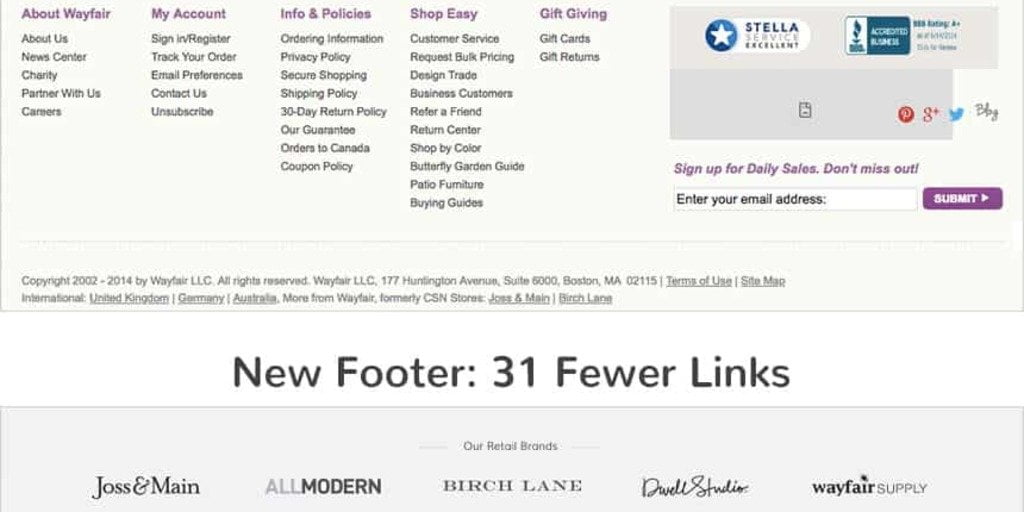
Does it look “right” to you?
It’s wrong!
Dozens of unnecessary links steal PR from other links that need it more. Don’t have a bulky footer. Make it skinny and reap the rewards of a fit-in-shape website 🙂
#3- Bad Practice Linking Out
Bad practice is anything that isn’t specific.
For example, people mention SEO somewhere on the page, so they link to Wikipedia’s page on SEO.
Or they mention links and they link to Brian Dean’s backlink guide.
Those links are a waste of PR and everyone’s time because people reading articles about SEO already know what SEO is. And people reading an article on, for example, building links with images know what backlinks are and don’t need to leave your site to relearn it.
Instead, use focused internal/external linking.
For example:
- if I talk about Twitter marketing- I’d link to Lisa’s article
- if I talk about link building- I’ll link to Sandeep’s article (I recently discovered it, it’s great!)
Good practice linking is just plain good sense.
#7- Increase Your Post’s Share Potential
Your post thrives when it’s seen and read by people. That’s how to grow your business.
While that’s true, you don’t have enough time and energy to promote it all the time.
Plus, it isn’t practical.
So what are you to do?
The answer is to let others share.
And the easiest way is to use click-to-tweet boxes to encourage activity.
Here’s how exactly:
Step 1– install the plugin from your WP dashboard (it’s free).
Step 2– Go into the post’s editor and choose a suitable place for your new tweet.
Then, Step 3– open the shortcode generator and write the witty tweet.
Note– If your post is long, space them out a bit. The point is that when someone wants to share, they can easily do it because the click-to-tweet box is nearby.
That’s it, folks. My simple SEO checklist has run its seven-part course. I guess all that’s left is to conclude the article…
“What, there’s a bonus”?
Oh yeah, now that you mention it…
Bonus- TF-IDF- Your Secret Weapon To EXTREME On-Page SEO
What is TF-IDF?
The term stands for Term Frequency- Inverse Document Frequency.
Got it?
No?
Yeah, confusing, I know.
TF-IDF is one of the oldest Google ranking factors and one gaining in prominence ever since Google rolled out its latest big updates.
It’s basically a way for Google to determine how relevant a post is to the query, by comparing it with the rest of the web. The relevant documents will contain (in a higher percentage) words and phrases connected to the query, and not those that are unconnected or miscellaneous.
They determine the relevancy by scanning the entire web of documents, but for your purposes, you want to match the relevancy of the first 10 results.
The words they have- you should too. The word they don’t use anywhere but you do- kick them out, now!
To get results, you need a tool (it’s free).
Introducing Site Auditor by Link-Assistant
First, download and install the tool.
Second, get ready to learn.
TF-IDF is a really powerful ranking factor and nailing it right can help you rank without links. So it’s beyond the scope of this article and I don’t want to waste your time.
Instead, I will direct you to a few helpful resources on the topic
- Matt Diggity’s new TF-IDF guide. Learn what it is and what you can do with it
- Learn to use the free TF-IDF tool- by Link-Assistant.
And a helpful video/demonstration:
I urge you to give TF-IDF a try. Only the name is intimidating. The rest is easy. Plus most people have no idea what it is. You use it and get an easy advantage.
Conclusion- On-Page SEO Never Seemed So Easy
Simple SEO checklist- 7+1 easy steps.
Do them! Religiously, stubbornly. But do them, even when you think on-page is the smallest part of the SEO equation do them. That it doesn’t matter anymore.
Do them, and watch your new post go far. It might not shoot to the first page right away. in fact, it certainly won’t.
But it will be primed, pumped, and ready to be promoted to the first page when the time comes.
And you can hasten it is coming with a bit of page aging (out of your control ); and a dash of smart link building (hint: Lisa has a great guide on her site- read it!)
Here’s the thing:
For the most part, whether you rank number #1 in Google, or not- is YOUR choice.
Now, what are you going to do about it? We would love to know more in the comments below!
Did you follow the simple SEO checklist?

Don't hesitate to visit my site, especially if you're interested in learning about Wealthy Affiliate, WordPress SEO, and how to thrive with affiliate marketing. If you do drop by- you're in for a treat- I promise:)
- Internally Linking for SEO in 2026: Link Like Crazy to Skyrocket Your Rankings - May 31, 2025
- How To Rank New Affiliate Marketing Websites In Google Right - December 15, 2023
- The Essential 7- A Simple SEO Checklist For Higher Rankings - May 29, 2023


Hi Nikola & Lisa, the article which you are shared is really awesome. The idea which you are included in this is really fresh. The checklist is really helpful. thank you for the post.
Hi Mike, welcome to Inspire to Thrive. What part of the checklist did you like the most? Nikola did a great job with this one. Thanks for coming by and have a wonderful day.
Thanks Mike, the checklist is at its best when used. So do use it to better your SEO and make sure to report your results here. I’m curious to know:)
Hi Nikola & Lisa,
Your article is great. The seven checklists are fascinating. However, Im more concerned about the content length and the use of long-tail keywords. May research by industry experts including Brian Dean of Backlinko has proven that content length plays a vital role in improving content visibility and search rankings. Articles in the rage of 1500-word to 2000 and above tend to rank better on SERP because they are more in-depth and has valuable information. So, the point is for bloggers and content marketers to create well-researched, in-depth content in the rage of about 2000-words and above. But for those who do not have the time to write more, you can go for 1200-word and 1500. But make sure your post is valuable and with the right keywords.
Now about long-tail keywords, I love using them in my content because they help to rank my articles. Long-tail keywords are SEO gold mine,so-to-speak. I give an instance. I recently wrote a guest post where I only used my seed keyword three times in the entire article. But before I wrote that post, I went to SEMruch and made a list of about 15 relevant long-tail keywords. The article was writing has already been written by experts like Neil Patel, so I was looking for a simple way out.
Hence, as I wrote the post, I spread the 15 related long-tail keywords throughout the article. Three weeks after it was published, the post was still ranking #3 on Google page two. And exactly a month two weeks it was #4 on SERP one.
It goes to show you the power of using relevant long-tail keywords in your content.
Hey Moss,
wow, what a monster comment. I see you’re passionate about long form content:)
And yeah, you’re right, longer usually ranks better. If for nothing else it will rank for more long tail keywords, because there’re more of them.
Thanks for commenting, buddy
Hey Sajid,
That’s great you learned something new and useful. Keep plugging away for a better tomorrow:)
Hi Nik
Great Tips shared.
Though I have been following a few of them many are new to me. Thank you so much for sharing such a lot of tips with this post.
Meta description is your ad copy! Yes, indeed that is a big shout out to the public about what it is all about if that is a well versed one sure people will get attracted. I am sure Nik is using Moz? am I right?
Moz got a lot of option to make a good Meta description.
Thanks, Lisa for Nik’s share here.
I found this post curated at BizSugar and upvoted too.
And dropped a comment.
Keep sharing
~ Phil
Thanks Phil,
Yeah, I’m using Moz. It’s my favorite tool.
I’m glad you learned something new.
Keep rocking:)
No problem glad it helped…
Hi Nicolar,
This is some powerful SEO piece you’ve published here and thanks to Lisa for allowing you share this.
I have just rushed through but trust me I’m coming back to this today. You mentioned TF-IDF, which is something I have on my to-do list. SEMrush has an OnPage Optimization feature that I think is similar to this.
It scans the first 10 entries on Google for a particular keyword and then tell you what they’ve done that you didn’t – the words used, the LSI keywords used, Internal links, external links.
Using this and tweaking your posts leads to better ranking even without any backlinks.
Powerful SEO stuff here and thanks for mentioning hemingwayapp, a tool I had no idea exists.
Hope you both are having a wonderful week
Hey Enstine,
You’re right about SEMrush, they do have that feature built in. I don’ t use it but only because I don’t use SEMrush- yet.
But everything you just mentioned, Site Auditor also does, and for free.
It’s worth it for those who don’t have a access to SEMrush.
Thanks for commenting:)
Nikola,
I have to bookmark and print your blog post! So much valuable information packed in one post. I have to “chew” on this topic for some time, and then talk to my webmaker…
I am now following you on Twitter and I have retweeted your tweet with a link to this post.
All the Best,
Martin
Thanks Martin, I’m glad you liked it. I know I put a lot of effort in it, and it’s really a joy for me to see people enjoy my work.
Thanks for the Twitter follow and i will follow you back,
pronto:)
The app you mention that can work out the average word count for the top 10 results is a great idea. All I would say is when you have the average I would go for 300 more on top of the average.
That’s reasonable Dexter.
For really low-competition keywords, oftentimes, if you make it slightly “wordier” it’s enough to rank above the competition. No links, no internal links, no nothing.
Only better content and comparable site authority (+ a bit of freshness)
Hi Nikola Roza,
Welcome on inspiretothrive.com with such an amazing article for helping to get Good ranking with the latest.
Nikola Roza, Content-length, Meta title, URL, Meta description, Internal linking & External linking these are important factors for a website to be on Top but what about OFF page activities.
What OFF page activities should follow to those are help?
Hi Nia, this checklist is mostly on-page SEO.
As for the off page stuff. I’d focus on getting a few good links so that content starts to rank for long tail keywords. Once that happens, it’ll begin to pick up links naturally.
Of course, long term brand building is key to
sustained success online, and in Google world.
Hii Nikola,
I like this 7 simple checklist, and i like the first concept increasing content length.
Thanks for this useful information
Thanks Nihal, I’m glad you learned something new.
Length= strength
Nikola that lead off is beyond awesome. Simple English guys. Nothing fancy. Nothing over the top. Simple, plain, average posts reap big time returns not just on Google, but through all channels. I crave simple. I need solutions as quickly as possible. Excellent post.
Hey, thanks Ryan.
It’s first in the post, but actually the last thing written.
The final burst of creativity…
Hey Nikola, Love this checklist! Content is king! I always like to try and outdo the top three competitors in terms of word count.
I think readability is huge too, the longer people stay on your page the better! I guess it makes sense, google wants quality for their users.
Hey Nick, you’re so right about readability. It’s the easy way to have you content stand out; as most folks are trying to sound smart, and not succeeding.
Thanks for commenting:)